Levoit Core 300S vs Core 300P
Both models ship with the same 3-stage Original filter and clean the air at almost the same rate. The 300S adds app control and draws less power, and the 300P costs less.
Get the 300S for app control and lower power draw. Get the 300P to spend less.
Levoit ships the Core 300S and Core 300P with the same 3-stage Original filter, and their clean-air delivery is 141 and 143 CFM. The real split is features and price. The 300S works with the VeSync app, Alexa and Google Assistant and draws 23 W at most. The 300P has no app, draws up to 56 W, and costs roughly 40 percent less on Amazon.
Side-by-Side Specs
| Spec | Levoit Core 300S | Levoit Core 300P |
|---|---|---|
| Price on Amazon | ~$150 | ~$90 |
| CADR | 141 CFM | 143 CFM |
| Room size (4.8 air changes per hour) | 219 sq ft | 222 sq ft |
| Noise, lowest to highest speed | 22 to 50 dB | 24 to 54.5 dB |
| Rated power | 23 W | 56 W |
| Weight | 5.95 lb | 7.9 lb |
| Filter included | 3-stage Original | 3-stage Original |
| Optional Levoit filters | Pet Allergy, Toxin Absorber, Smoke Remover | Pet Allergy, Toxin Absorber, Smoke Remover |
| Sleep Mode | Yes | Yes |
| VeSync app and schedules | Yes | No |
| Alexa and Google Assistant | Yes | No |
What They Share
Both units ship with Levoit’s 3-stage Original filter installed. Levoit describes the stages as a pre-filter for hair, dust and large particles, a main filter rated to remove 99.97 percent of particles down to 0.3 microns, and a high-density activated carbon layer for gases and odors.
Airflow is close to identical. The 300S delivers 141 CFM of clean air and the 300P delivers 143 CFM, so at 4.8 air changes per hour they suit rooms of 219 and 222 sq ft. Levoit lists Sleep Mode on both product pages.
Can you use the Pet Allergy filter in either model?
Levoit lists its Pet Allergy, Toxin Absorber and Smoke Remover filters as optional replacements on both the Core 300-P and Core 300S-P product pages. Neither model ships with a pet filter, so a pet household picks the unit first and the filter at the first replacement. Check the compatibility line on the filter’s own listing before you order.
Where the 300S Has the Edge
The 300S is the smart model. Levoit’s Core 300S-P page lists VeSync app control with schedules and a timer that runs from 1 to 24 hours, plus voice control through Amazon Alexa and Google Assistant.
It is also the more efficient unit. Rated power is 23 W against 56 W for the 300P. Run at full rated power around the clock for a year, that 33 W gap comes to about 289 kWh. At its lowest speed the 300S is rated at 22 dB, two decibels under the 300P, and it weighs 5.95 lb against 7.9 lb.
Where the 300P Has the Edge
The 300P costs roughly 40 percent less on Amazon for the same filter and slightly more airflow, 143 CFM against 141. Its controls are the buttons on the unit, so there is no app to install and no Wi-Fi network to join. For a single room where you plan to set a speed and leave it, the 300P delivers the same filtration for less money.
The Products
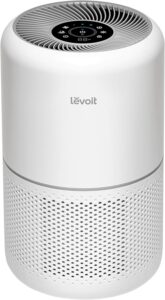
Levoit Core 300S
Best for buyers who want schedules and speed changes from a phone or a voice assistant, and for rooms where the purifier runs all day. It ships with the 3-stage Original filter, and Levoit lists the Pet Allergy filter as an optional replacement.
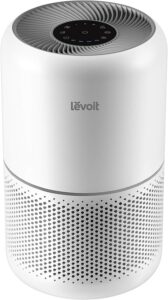
Levoit Core 300P
Best for buyers who want the lower price and button controls with no app. It ships with the same 3-stage Original filter as the 300S and accepts the same optional Pet Allergy filter.
Frequently Asked Questions
Does the P in Core 300P mean it comes with a pet filter?
Levoit’s current listings are the Core 300-P and the Core 300S-P, and both ship with the 3-stage Original filter. The Pet Allergy filter is sold separately for either model. Of the two, only the 300S-P lists the VeSync app and voice control.
I have both allergies and a pet. Which should I get?
Both move nearly the same amount of air through the same filter, so choose on price and app control. If you want a filter aimed at pet dander, Levoit’s Pet Allergy filter is an optional replacement for both models.
Which Core 300 model is better for a bedroom?
Both list Sleep Mode. The 300S is rated at 22 dB on its lowest speed against 24 dB for the 300P, and its app adds schedules and a timer you can set from bed.
Does the 300S cost less to run?
Its rated power is 23 W against 56 W for the 300P. At full rated power around the clock, the difference is about 289 kWh a year; multiply by your electricity rate per kWh for the dollar figure.