Managing Air Quality in a Multi-Pet Household
Two cats produce roughly twice the dander of one. Three dogs mean three times the odor load. Multi-pet households need a more deliberate approach to air filtration than a single-pet home, and the usual single-unit strategy rarely keeps pace.
The air quality challenges of a multi-pet household are not simply a scaled-up version of single-pet challenges. Multiple animals produce additive allergen loads, but they also tend to occupy different parts of the home at different times, which means dander and odor sources are distributed across a wider area rather than concentrated in one spot. A single purifier in the living room that might handle a one-cat household adequately will fall significantly short when two cats and a dog are each shedding dander in different rooms throughout the day.
Multi-species households add another layer of complexity. Cat and dog allergens are distinct proteins, and some people are allergic to one but not the other. Households with both species are managing two separate allergen types simultaneously, each requiring the same HEPA filtration approach but potentially at higher combined concentrations than a single-species home of equivalent animal count.
How Allergen Load Scales with Pet Count
Dander production is roughly proportional to the number and size of animals in the home. Two medium-sized dogs produce approximately twice the dander of one, though individual variation means this is not a precise multiplier. What changes more significantly than the raw production rate is the distribution pattern. With multiple pets occupying different rooms, sleeping in different spots, and moving through the home independently, dander is deposited across a larger total surface area and becomes airborne from more locations simultaneously.
Filter replacement frequency is one of the clearest practical indicators of how much harder multi-pet households are on air purifiers. A filter that lasts six months in a pet-free home may last three months with one cat and as few as four to six weeks with three or four animals. Planning for more frequent replacement and building that cost into the decision when choosing a unit is more accurate than assuming manufacturer-rated filter life will apply.
One large unit or multiple smaller ones?
For multi-pet households in larger homes, the answer is usually multiple units. A single premium unit with 700 sq ft coverage placed in the living room does not filter the air in the bedrooms, the hallway, or the rooms where other pets spend time. Two mid-range units placed strategically, one in the main living area and one in the primary bedroom, cover the spaces that matter most for both waking and sleeping hours. For open-plan homes or smaller apartments, one well-sized unit centrally placed can cover the whole space more effectively than two units in corners.
Placement Strategy for Multi-Pet Homes
Identify the two rooms where people and pets overlap most and prioritize those first. In most households that means the main living area and the primary bedroom. The living room is where dander accumulates fastest due to combined pet and human activity. The bedroom matters because allergen exposure during sleep is the longest continuous exposure window of the day, and even pets that are kept out of the bedroom deposit dander that travels through airflow.
Rooms where pets sleep exclusively, such as a dedicated cat room or a dog crate area, benefit from a smaller unit running continuously to prevent that space from becoming a high-concentration dander reservoir that spreads to the rest of the home through normal air circulation. A budget unit like the Core 300P is appropriate for this role since filtration performance matters more than coverage area in a room that humans do not occupy for extended periods.
Position each unit away from walls and corners to allow unrestricted airflow on all intake sides. In rooms where the pet has a designated resting spot, placing the purifier within several feet of that spot means the unit is drawing in the highest dander concentration at its source before it disperses further into the room.
Filter Management in Multi-Pet Households
Check filters visually every four weeks rather than relying on indicator lights alone. In high-dander environments, indicator systems often underestimate actual filter loading because they measure time or airflow rather than particle accumulation directly. A filter that looks dark gray or has visible hair and debris embedded in the pre-filter layer is overdue for attention regardless of what the indicator shows.
Washing the pre-filter layer, where the unit includes a washable pre-filter, every two to three weeks in a multi-pet home extends the life of the main HEPA filter by preventing the pre-filter from becoming so clogged that it restricts airflow and reduces the unit’s effective cleaning rate. The Blueair Blue Pure 311’s washable fabric pre-filter is a particularly practical feature for this reason in high-load pet environments.
Recommended Air Purifiers for Multi-Pet Households
For full comparisons and detailed specs, see the main pets and odors guide. In multi-pet homes, the mid-range and premium picks carry more weight than in single-pet situations, and running two units is often more effective than one.
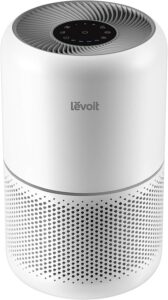
Levoit Core 300P
In a multi-pet home, the Core 300P works best as a secondary unit for a dedicated pet room, a hallway, or a bedroom, rather than as the primary unit for the main living area. Its 219 sq ft coverage is appropriate for smaller enclosed spaces, and its low price makes it practical to run two or three units simultaneously across different rooms without a large total investment. The pet-specific filter configuration handles dander and odor adequately for lower-traffic spaces.
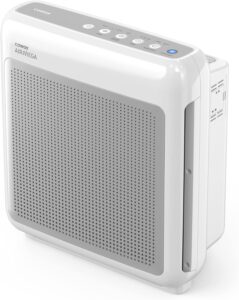
Coway Airmega 200M
The Airmega 200M is the primary living area unit for most multi-pet households at the mid-range price point. Its auto mode is particularly valuable when multiple animals are moving through the room at different times, because it responds to dander spikes from each animal’s activity without requiring manual adjustment throughout the day. Running one Airmega 200M in the living room and one Core 300P in the bedroom covers the two most important spaces in a typical home for around $260 total.

Rabbit Air MinusA2
The MinusA2 is the strongest single-unit option for a multi-pet main living area at 700 sq ft coverage. Its six-stage filtration system with the Pet Allergy customizable filter handles the higher combined allergen load of multiple animals more effectively than a standard two-stage HEPA and carbon unit. The 20.8 dB low-speed noise rating means it can run continuously without becoming intrusive, which is important in a home where the unit needs to operate around the clock to keep pace with ongoing dander production from multiple sources.
Frequently Asked Questions
How many air purifiers do I need for a multi-pet household?
A useful starting point is one unit per primary living space: one for the main living area and one for the bedroom. In larger homes with multiple floors or several rooms where pets spend significant time, additional units in those spaces make a meaningful difference. The total coverage you need is less important than making sure the rooms where people spend the most time, and especially where they sleep, have active filtration running continuously.
Do I need a different type of filter for a household with both cats and dogs?
No. True HEPA filtration captures both Fel d 1 (cat) and Can f 1 (dog) allergen particles effectively regardless of species. The filter does not need to be species-specific to work. What matters more in a mixed-species household is the total allergen load, which argues for higher coverage capacity and more frequent filter replacement rather than a different filter type.
How often should I replace filters in a home with three or more pets?
Plan for roughly half the manufacturer-rated filter life as a baseline, and adjust based on visual inspection. A household with three or more pets running a purifier continuously should check the pre-filter every two to three weeks and the main HEPA filter every six to eight weeks. When the pre-filter is visibly discolored or airflow from the unit feels reduced, it is time to replace or wash depending on the filter type. Indicator lights are a starting point, not a reliable schedule in high-load environments.