Pet Owner’s Guide to Air Purifiers (2026)
Pet dander never fully goes away. It just circulates. This guide covers what works for dander, allergens, and persistent odors at three price points, with clear tradeoffs for each.
Our Top Picks at a Glance
Pet owners deal with an air quality challenge that most purifier guides underestimate. Dander does not settle and stay put like ordinary dust does. Because pet dander particles are so small and lightweight, they stay suspended in the air for hours after a pet leaves the room, get stirred back up every time someone walks across the carpet, and accumulate in upholstery at a rate that regular cleaning cannot fully address. Add persistent odors from litter, bedding, or simply having animals in the house, and the air quality picture gets complicated fast.
The good news is that air purifiers work well for this problem, more reliably than for some other indoor air challenges. The key is understanding what specs matter for pet households specifically, and which products deliver on those specs in real use.
What to Look for in a Pet-Friendly Air Purifier
Three factors separate a purifier that works well for pets from one that just looks good on paper.
The first is true HEPA filtration. HEPA filters capture 99.97% of particles at 0.3 microns, which covers pet dander and most other airborne allergens. Be cautious of filters labeled “HEPA-type” or “HEPA-style,” as these do not meet the same standard and will underperform in a pet household.
The second is an activated carbon layer. HEPA filtration handles particles, but odors are a gas-phase problem that requires a different solution. Activated carbon adsorbs the volatile organic compounds that cause pet smells. Some budget purifiers skip this layer entirely, which means they will remove dander from the air but do nothing for the smell of wet dog or a litter box in the next room. For pet households, a dedicated carbon filter is not optional.
The third is coverage area relative to where your pets spend time. A purifier rated for 200 sq ft does very little in a 400 sq ft open living room where the dog sleeps on the couch. The CADR (Clean Air Delivery Rate) number tells you how much clean air the unit moves per minute. A higher CADR means faster air exchange in larger rooms.
Comparison at a Glance
| Model | Tier | Coverage | CADR | Carbon Filter | Noise (Low) | Price | Link |
|---|---|---|---|---|---|---|---|
| Levoit Core 300P | Budget | 222 sq ft | 143 CFM | Yes | 24 dB | ~$90 | Amazon |
| Coway Airmega 200M | Mid-Range | 361 sq ft | 246 CFM | Yes | 24.4 dB | ~$218 | Amazon Sylvane |
| Rabbit Air MinusA2 | Premium | 408 sq ft | 193 CFM | Yes + Custom | 25.6 dB | ~$600 | Sylvane Amazon |
A note on filter replacement costs
In pet households, filters clog faster than the manufacturer schedule suggests. Plan on replacing filters every 4 to 6 months, not the standard 6 to 12, especially in homes with multiple pets or heavy shedders. Factor that ongoing cost into your decision alongside the upfront price.
Our Picks, Reviewed
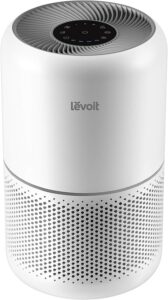
Levoit Core 300P
Best for: Single-pet households, bedrooms, renters, and anyone trying an air purifier for the first time.
The Core 300P is the right starting point for someone with one pet and one problem room. It is compact enough for a nightstand or desk and quiet enough to run overnight. The three-stage filtration system covers dander and odors together with a pre-filter, true HEPA, and activated carbon.
Its limitation is clear: at 222 sq ft of coverage, it is not a whole-room solution for larger spaces. In a bedroom or home office it performs well. In a living room where a dog spends most of the day, you will notice the gap. Think of the Core 300P as a bedroom solution or a supplement to a larger unit in the main living area.
Strengths
- Quiet at low settings (24 dB)
- Compact footprint for small spaces
- Handles both dander and odors
- Affordable entry point to upgrade from
Limitations
- Coverage area too small for living rooms
- Replacement filters add up over time
- No air quality display or sensor
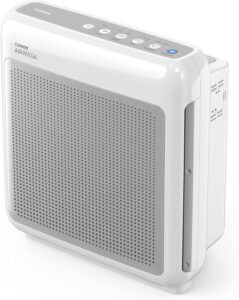
Coway Airmega 200M
Best for: One or two pets in a living room or open bedroom, buyers who want real-time air quality feedback, and households where odor is as much a concern as dander.
The Airmega 200M is the purifier that comes up most often when we talk to pet owners who have tried a budget option and want something that covers the room they are in. It handles 361 sq ft with a CADR of 246 CFM, which puts it comfortably in range for a living room or open bedroom where a pet spends most of its time.
The four-stage filtration includes a pre-filter for hair and large particles, a true HEPA layer, an activated carbon filter for odors, and a vital ion layer that helps capture ultra-fine particles. The air quality indicator on the front panel gives you real-time feedback, which is especially useful in pet households because dander spikes are invisible and it is easy to underestimate how much the air quality has changed. When the indicator turns red, you know the pet has been particularly active or the filter needs attention.
For most single-pet households, this is the one we would recommend first. It covers more ground than the budget tier, addresses both dander and odors seriously, and runs quietly enough on lower settings to be unobtrusive in a shared living space.
Strengths
- Real-time air quality display
- Solid coverage for most living rooms
- Four-stage filtration handles both dander and odor
- Strong value for the price
Limitations
- Not enough for large open floor plans
- Fan noise increases noticeably on higher settings
- No smart home or app integration
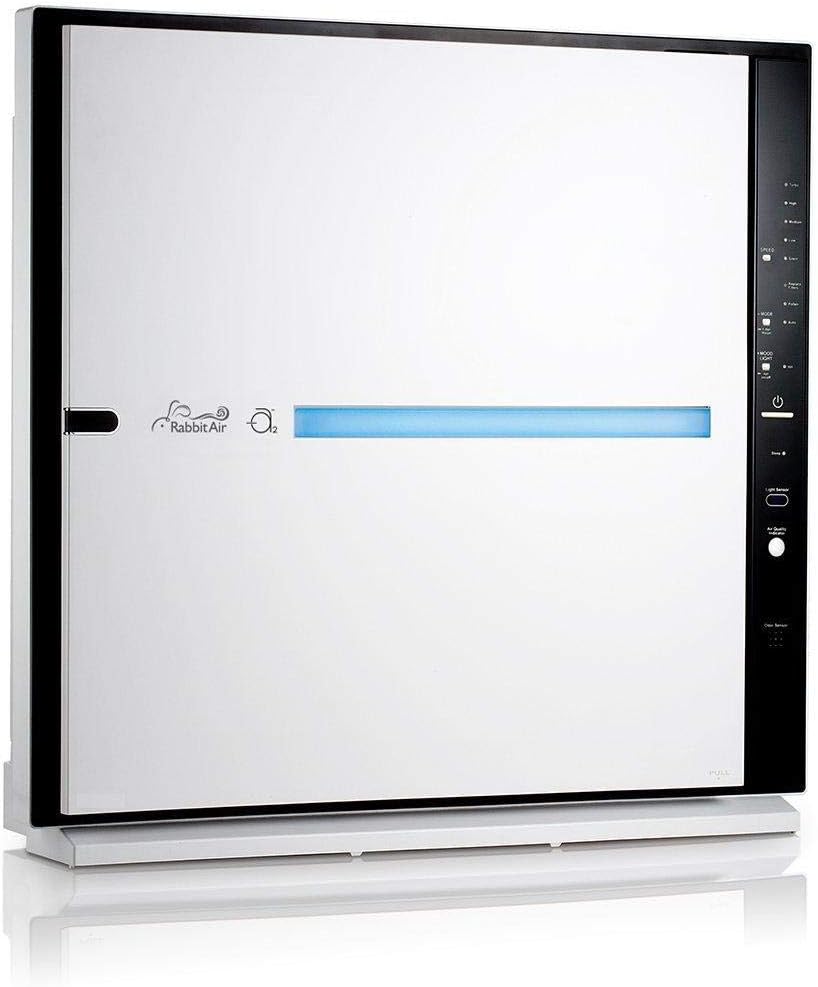
Rabbit Air MinusA2
Best for: Multiple pets, households with diagnosed pet allergies, and anyone who has already tried a mid-range option and wants the deepest filtration and the quietest high-speed operation as a meaningful step up.
The MinusA2 is built for households where pet air quality is a persistent, serious concern. It is rated for about 408 sq ft at an allergy-grade four air changes per hour, and up to 815 sq ft at a lighter turnover, enough for a large room or a modest open-plan living area, and the six-stage filtration system goes further than anything else in this guide. The standout feature for pet owners is the customizable filter panel where you select a specialty filter based on your situation. For pets, the “Pet Allergy” panel includes an extra layer specifically targeting pet dander and allergens.
The wall-mount option changes the practical calculus meaningfully. In a home where floor space is limited or where pets tend to knock items over, mounting the unit on the wall removes it from the animal’s reach and keeps airflow at a height where dander and airborne particles circulate. At 25.6 dB on the lowest setting it runs quietly, and because it tops out at just 51.3 dB it stays the least intrusive in this guide even at higher speeds.
At this price point, the MinusA2 is a considered purchase. It makes the most sense for households with multiple pets, a family member with diagnosed pet allergies, or a preference for the deepest filtration and the lowest noise ceiling in this guide. The per-year filter cost is also lower relative to its coverage area than the budget options, which helps offset the upfront price over time.
Strengths
- Purpose-built pet allergy filter panel
- Wall-mountable, pet-proof placement
- Quietest unit in this comparison
- Covers large open floor plans
- App control and smart scheduling
Limitations
- Significant upfront investment
- Wall mounting requires installation effort
- Lower CADR than coverage area suggests
How to Get the Most Out of Your Air Purifier as a Pet Owner
Placement matters more than most guides acknowledge. Putting a purifier in a corner behind furniture defeats the purpose because air needs to circulate freely into and out of the unit. Position it in the room where your pet spends the most time, at least a foot from walls and furniture on all sides, and ideally close to where the animal rests since that is where dander concentration is highest.
Running the unit continuously on a low setting outperforms running it on high for a few hours. Dander accumulates steadily throughout the day, so consistent low-level filtration keeps airborne particle levels lower overall than periodic burst cleaning. Most of the units in this guide are quiet enough on their lowest setting that continuous operation is not disruptive.
Filter maintenance in a pet household is non-negotiable. Check pre-filters monthly and rinse or vacuum them as needed. A clogged pre-filter makes the HEPA layer work harder and reduces overall performance before the replacement reminder light comes on. Replace HEPA and carbon filters every 4 to 6 months, well ahead of the 12-month manufacturer schedule, and more often if you have multiple pets or a heavy shedder.
Frequently Asked Questions
Do air purifiers help with pet allergies?
Yes, with a meaningful caveat. A true HEPA air purifier captures 99.97% of airborne particles at 0.3 microns, which includes pet dander. Running one continuously will reduce allergen concentration in the room. What it cannot do is eliminate allergens that have already settled into carpets, upholstery, and bedding. For best results, pair a HEPA air purifier with regular vacuuming using a HEPA-filter vacuum and washing pet bedding weekly.
Where should I put an air purifier in a home with pets?
In the room where your pet spends the most time. For most households that is the main living area during the day and the bedroom at night. If you have one unit, prioritize the bedroom since that is where you spend the longest uninterrupted stretch of time breathing indoor air. If your budget allows two units, one in the living area and one in the bedroom covers the majority of your daily exposure.
How often do I need to replace filters in a pet household?
More often than the manufacturer schedule suggests. Most brands recommend filter replacement every 6 to 12 months under normal conditions. In a home with pets, plan for every 4 to 6 months for HEPA and carbon filters, and check the pre-filter monthly. A clogged pre-filter reduces the efficiency of the entire system before any indicator light tells you there is a problem.
Can one air purifier cover my whole home?
Generally not. Air purifiers work on the room they are in. An open floor plan can sometimes be served by a single high-CADR unit placed centrally, but closed rooms require their own coverage. The Rabbit Air MinusA2, rated for about 408 sq ft at an allergy-grade air-change rate, handles a large room or a modest open plan, but a bedroom with the door closed needs its own unit regardless of what is running elsewhere in the house.
Is the Rabbit Air MinusA2 worth the price for pet owners?
For households with multiple pets or a family member with diagnosed pet allergies, yes. The purpose-built Pet Allergy filter panel, the wall-mount option that keeps it out of reach of animals, and the low 51.3 dB noise ceiling justify the premium for buyers who have already tried budget or mid-range options and found them insufficient. For a single-pet household without serious allergy concerns, the Coway Airmega 200M covers most of what you need at a much lower price point.
Quick Buyer Checklist
Before you buy, ask yourself these four questions
1. How many pets and how large is your space? One pet in a bedroom points to the Core 300P. One or two pets in a living room points to the Airmega 200M. Multiple pets or a large open floor plan points to the Rabbit Air MinusA2.
2. Is odor or dander your bigger concern? All three picks include activated carbon for odor, but if smell is your primary complaint the Airmega 200M’s four-stage system handles it most consistently at the mid-range price point.
3. Does anyone in the household have diagnosed pet allergies? If yes, move up at least one tier from where you think you need to be. The gap between manageable and effective is usually one tier.
4. Will it run overnight? If yes, noise level matters. On the lowest setting all three sit within about a decibel and a half, the Core 300P at 24 dB, the Airmega 200M at 24.4 dB, and the MinusA2 at 25.6 dB. The MinusA2 pulls ahead at higher speeds, where its 51.3 dB ceiling stays below the mid-50s maximums of the other two, so it is the least intrusive if you run it faster overnight.