
Best Air Purifiers for Sleep and Bedroom Air (2026)
Noise level matters more in a bedroom than anywhere else. This guide covers the purifiers that clean effectively while staying quiet enough to run overnight, at budget, mid-range, and premium price points.
Our Top Picks at a Glance
Sleep is the longest uninterrupted stretch of time most people spend breathing the air in one room. A bedroom with elevated allergen, dust, or VOC levels exposes you to those conditions for six to nine hours straight, with no movement to dilute the concentration. That is a meaningful difference from daytime air quality exposure, where you move between rooms and spend time outdoors.
The challenge with bedroom air purifiers is that the qualities that make one effective during the day can make it useless at night. A loud fan on high speed cleans air fast, but it also keeps you awake. The right bedroom purifier runs quietly and continuously at a low speed, keeping particle levels consistently low through the night rather than cleaning in bursts.
What to Look for in a Bedroom Air Purifier
Noise level at the lowest fan speed is the most important spec for bedroom use and the one most often buried in marketing copy. Look for the decibel rating specifically on the lowest setting, not the average or the high setting. Anything at or below 25 dB is quiet enough for overnight use without disruption. The range between 25 and 35 dB is acceptable for most people but may be noticeable to light sleepers. Above 35 dB on low will likely be disruptive in a quiet bedroom.
Coverage area should match your bedroom, not exceed it by too large a margin. An oversized unit runs on lower fan speeds more of the time, which is actually an advantage for noise, but a unit that is too small for the room will have to work at higher speeds to keep up, generating more noise. Match coverage area to room size reasonably closely.
True HEPA filtration is non-negotiable for the same reasons it matters everywhere else. Bedroom air quality problems are almost always particle-based: dust mites, skin cells, pet dander brought in from other rooms, and pollen tracked inside. HEPA captures all of these. A purifier without it is largely decorative for sleep purposes.
Finally, consider light output. Some purifiers have bright indicator lights or displays that glow at night. This is a minor detail that review sites rarely flag, but a bright LED panel at the foot of the bed can affect sleep quality in light sleepers. All three picks below have dim or auto-dimming night modes.
Comparison at a Glance
| Model | Tier | Coverage | CADR | True HEPA | Noise (Low) | Price | Link |
|---|---|---|---|---|---|---|---|
| Levoit Core 300S | Budget | 219 sq ft | 141 CFM | Yes | 22 dB | ~$100 (S) / ~$200 (SP) | Amazon |
| Blueair Blue Pure 311i Max | Mid-Range | 439 sq ft | 283 CFM | HEPASilent | 23 dB | ~$230 | Amazon |
| Rabbit Air MinusA2 | Premium | 408 sq ft | 193 CFM | Yes | 25.6 dB | ~$620 | Amazon |
Why low-speed noise matters more than CADR for bedrooms
CADR measures how fast a purifier cleans the air at maximum speed. But a purifier running on high in a bedroom at night is rarely practical. The relevant performance metric for sleep is how well the unit cleans at its lowest, quietest setting. The Blueair and Rabbit Air both deliver meaningful air exchange rates even on their lowest speeds. Choosing a unit with a higher CADR than your room needs means it can run even quieter than rated while still maintaining clean air overnight.
Our Picks, Reviewed
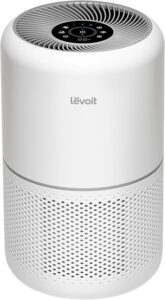
Levoit Core 300S
Best for: Bedrooms up to 220 sq ft, first-time buyers, renters, and light sleepers who need a quiet overnight unit without spending more than necessary.
The Core 300S earns its place in this category primarily because of its noise profile. At 22 dB on its lowest setting, it sits just below the threshold most people describe as perceptible white noise. You can hear it if the room is completely silent and you are listening for it, but it does not pull attention the way a fan or a louder air purifier does. For most people, it disappears into the background within the first night.
Coverage is limited to 219 sq ft, which works well for a standard bedroom but falls short in a larger master. The Amazon listing opens on the Core 300S-P (SP), which adds app control and scheduling and costs roughly twice the base model. If you want to set the unit to ramp up before bedtime and drop to its quietest mode automatically, that is the version to choose. If smart features are not a priority, select the standard Core 300S on the same product page for the lower price listed in the specs above, the filtration and noise performance are identical. The only difference is the SP’s Wi-Fi connectivity and app integration. Either way, Sleep mode dims the indicator light automatically when the room darkens, which is a small but appreciated detail.
Strengths
- 22 dB on low is quiet enough for overnight use
- Auto-dimming light avoids bedroom glow
- App scheduling lets you pre-clean before bedtime
- Strong value at the budget price point
Limitations
- 219 sq ft is tight for larger bedrooms
- No wall-mount option
- Filter replacement more frequent than premium picks
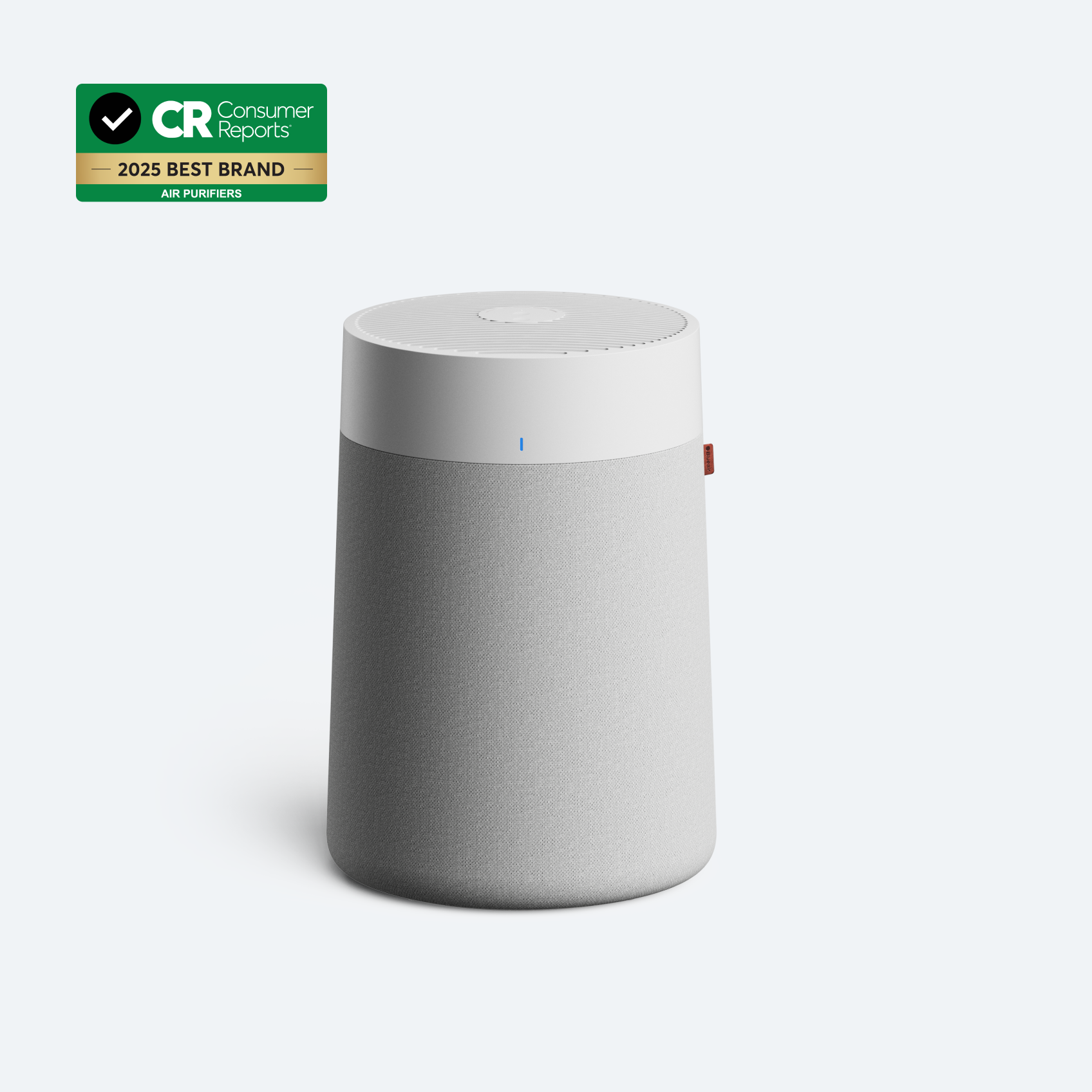
Blueair Blue Pure 311i Max
Best for: Standard to large bedrooms up to 440 sq ft, couples, and anyone who wants app-connected auto-adjustment overnight without the noise penalty of a conventional HEPA unit.
The 311i Max is the mid-range pick for sleep because it solves the two main problems simultaneously: it is quieter than any conventional HEPA purifier in its price range (23 dB on low), and it covers a realistic master bedroom at 439 sq ft. Blueair’s HEPASilent technology combines electrostatic charging with mechanical filtration, which produces the same particle capture rate as standard HEPA but with less airflow restriction, meaning the fan does not have to work as hard to move the same volume of air. Less fan effort means less noise at any given speed.
The Auto mode is particularly useful for sleep. The integrated particle sensor monitors air quality continuously and adjusts fan speed when it detects a change, such as when a window is cracked, when you return from the bathroom at night, or when morning activity in the rest of the house stirs allergens. In practice this means the unit is often barely running at 3 AM when the air is stable, and ramps up appropriately when conditions change, without you having to touch anything. Wi-Fi connectivity and app control round out the package, letting you check air quality and adjust fan speed remotely, a differentiator from every other unit in this comparison.
Strengths
- 23 dB on low, quieter than most HEPA units
- Auto mode adjusts overnight without waking you
- Covers real master bedrooms at 439 sq ft
- Wi-Fi app control with 5 fan speeds, including a dedicated Night mode
Limitations
- No washable pre-filter; the filter cartridge is replaced roughly every 9 months
- No wall-mount option
- HEPASilent is not identical to True HEPA certification

Rabbit Air MinusA2
Best for: Large or allergy-heavy bedrooms where six-stage, customizable filtration matters more than shaving the last few decibels off an already-quiet unit, and buyers who want to wall-mount to keep floor space clear.
The Rabbit Air MinusA2’s lowest-setting noise is rated at 25.6 dB, in the same comfortably quiet range as the other two picks in this guide (22 to 23 dB) rather than a dramatic step down. Where the MinusA2 earns its premium position is filtration depth: a six-stage system with a customizable filter layer, not a single quiet number. Rated coverage is 408 sq ft at the 4-changes-per-hour standard used throughout this guide, or up to 815 sq ft if a lighter 2-changes-per-hour turnover is acceptable in a larger room. This is the unit for households prioritizing thorough particle and odor removal over shaving another decibel or two off an already-quiet unit.
The six-stage filtration system covers particle removal, odor control, and a customizable filter layer you select based on your household’s primary concern. For sleep use, the Toxin Absorber or Odor Remover panel makes sense if VOCs from new furniture, paint, or cleaning products are a concern in the bedroom. The light sensor automatically transitions the unit to sleep mode when the room darkens and resumes normal operation when light returns, which means you never have to remember to adjust it at bedtime.
Wall mounting is a practical advantage in a bedroom context. A floor-standing purifier near the bed means dealing with a cord across the floor and taking up nightstand or floor space. Wall-mounted, the MinusA2 pulls air from head height, which is exactly where overnight allergen exposure occurs, and disappears from the floor plan entirely. Installation requires a single wall anchor; the unit ships with mounting hardware.
Strengths
- Six-stage filtration is the deepest system in this comparison
- Light sensor sleep mode requires zero manual adjustment
- Wall mount keeps floor space clear
- Customizable filter panel for specific bedroom concerns (odor, VOCs, extra allergy protection)
- 815 sq ft coverage available at a lighter turnover rate
Limitations
- Significant upfront cost compared to other picks
- Wall mounting requires some installation effort
- Loudest of the three picks on low, though still comfortably quiet at 25.6 dB
How to Set Up Your Bedroom Air Purifier for Better Sleep
Run the unit continuously rather than only at night. Allergens and particles accumulate in a bedroom throughout the day from foot traffic, open windows, and fabrics that release settled particles when disturbed. A purifier that only runs while you sleep starts each night with whatever was accumulating since morning. Running it on low throughout the day means the room is already at low particle levels when you get into bed.
Position the unit away from the headboard wall and closer to the foot of the bed, or beside the bed at a distance of at least two feet. This keeps the airflow pattern from blowing directly on the sleeper while still circulating the air in the breathing zone effectively.
Close the bedroom door. An open door invites allergens from the rest of the house, pet dander, dust stirred by activity in other rooms, and cooking odors. A closed bedroom with a purifier running is a controlled environment. An open one is not.
Use the scheduling or auto features if available. Running the unit on a higher speed for one to two hours before you typically go to sleep, then dropping to the lowest speed at bedtime, gives you pre-cleaned air to start the night and near-silent operation once you are asleep. The Core 300S-P (SP) supports this through its app, and the Rabbit Air MinusA2 handles it automatically via its built-in light sensor.
Frequently Asked Questions
Is it safe to run an air purifier in the bedroom all night?
Yes. All three units in this guide are designed for continuous operation. Running a HEPA air purifier overnight is not only safe but is one of the most effective ways to reduce allergen exposure since you are breathing the same air for hours at a time. The only detail to watch is that you are using a true HEPA unit and not an ionizer or ozone generator, which can produce byproducts that are not suitable for prolonged exposure in an enclosed room.
Where should I put an air purifier in the bedroom?
On the floor or a surface at roughly breathing height, at least two feet from the bed, with clearance on all sides for airflow. Avoid placing it directly behind the headboard, in a corner, or under furniture where airflow is restricted. Beside the dresser or near the foot of the bed on the floor both work well for most bedroom layouts. If wall mounting is an option, the Rabbit Air’s wall mount positions the unit at ideal breathing-zone height and eliminates floor placement entirely.
Does an air purifier help with snoring or sleep apnea?
Air purifiers address airborne allergens and particles, not the structural causes of snoring or sleep apnea. However, if nasal congestion from allergens is contributing to mouth breathing or snoring, reducing allergen levels in the bedroom can sometimes reduce the severity of those symptoms. It is not a substitute for medical treatment of sleep apnea, but it is a reasonable complementary step for people whose congestion is allergy-related.
What noise level is acceptable for a bedroom?
Consistent background sounds below 30 dB generally fall below the threshold most people notice during sleep. The Core 300S at 22 dB, the Blueair 311i Max at 23 dB, and the Rabbit Air MinusA2 at 25.6 dB all fall comfortably below this level, with the Core 300S rating quietest of the three. If you are a particularly light sleeper or share a room with someone who is, any of the three picks in this guide should be unobtrusive, though the Core 300S gives the most margin.
Can one air purifier cover the whole bedroom or do I need multiple units?
One unit is sufficient for most bedrooms with the door closed, as long as the unit’s coverage area matches the room size. The Core 300S covers bedrooms up to about 220 sq ft, the Blueair 311i Max covers up to 439 sq ft, and the Rabbit Air MinusA2 is rated for 408 sq ft at that same standard (or up to 815 sq ft with a lighter turnover rate). If your bedroom is larger than 400 sq ft or has an attached bathroom or sitting area, the Rabbit Air or two smaller units would be the better approach.
Quick Buyer Checklist
Four questions to find the right unit for your bedroom
1. How large is your bedroom? Under 220 sq ft, the Core 300S is sufficient. Between 220 and 440 sq ft, the Blueair 311i Max is the better fit. Larger than that, or a large master where filtration depth matters more than raw square footage, points to the Rabbit Air.
2. How sensitive are you to noise? Most people sleep fine with any of the three picks in this guide; all rate under 26 dB on low. If you want the single quietest option, the Core 300S rates lowest at 22 dB. Choose the Rabbit Air if six-stage, customizable filtration matters more to you than shaving off another decibel or two.
3. Do you have allergies or pets? If yes, move up one tier from where room size alone would suggest. The filtration gap between tiers matters more when allergen load is higher.
4. Is floor space a concern? If your bedroom is small or already crowded, the Rabbit Air’s wall-mount option is worth the premium on its own. The Core 300S is compact enough to sit on a nightstand if needed.