Managing Dust Allergies in the Home
Dust allergies are not caused by dust itself but by what lives in it. Understanding the actual triggers makes it much easier to choose the right approach and stop cleaning around the problem.
When someone says they are allergic to dust, what they almost always mean is that they are allergic to dust mite waste proteins, not to the dust particles themselves. Dust mites are microscopic arachnids that live in soft furnishings throughout the home, feeding on shed human skin cells. Their fecal particles and body fragments are the actual allergens, and they are small enough to become airborne when disturbed and remain suspended long enough to be inhaled.
This distinction matters because it changes what works. Reducing visible dust through regular cleaning helps, but it does not address the primary allergen source, which is the mite population living deep in mattresses, pillows, upholstered furniture, and carpet. A room can look clean and still have very high dust mite allergen concentrations in the air and on surfaces. Effective dust allergy management requires a combination of surface-level control, environmental conditions management, and air filtration.
Where Dust Mites Concentrate
Mattresses are the single largest dust mite habitat in most homes. The combination of warmth, humidity from body heat and perspiration, and a continuous supply of shed skin cells creates ideal conditions for mite populations to thrive. A mattress that has been in use for several years without an allergen-proof encasement can contain millions of mites and a significant accumulated load of allergen proteins. The same conditions apply to pillows, though their smaller size means a proportionally lower total population.
Upholstered sofas and armchairs are the second major habitat, particularly in rooms where people spend extended time. Carpet holds mites at floor level where walking and movement continuously disturb and aerosolize the allergen particles. Soft toys, particularly those that spend time in bedrooms, are a frequently overlooked reservoir that can maintain high allergen levels in the breathing zone of a child’s sleeping area.
Humidity is the environmental lever most people overlook
Dust mites cannot survive in low humidity. They absorb moisture from the surrounding air rather than drinking water directly, and populations collapse when relative humidity drops below 50 percent consistently. Maintaining indoor humidity between 40 and 50 percent is one of the most effective long-term strategies for reducing dust mite populations throughout the home. A hygrometer to monitor humidity costs very little, and a dehumidifier in high-humidity rooms can meaningfully reduce the conditions that sustain mite populations over time.
Surface Control Strategies That Work
Allergen-proof encasements for mattresses and pillows block the existing mite population inside the filling material while preventing new allergen accumulation on the sleeping surface. They are the highest single-impact purchase for dust allergy management and work regardless of how old or heavily colonized the mattress already is. The encasement does not need to eliminate the mites inside, it simply prevents their allergen particles from reaching the breathing zone during sleep.
Washing bedding weekly at 130 degrees Fahrenheit kills the mites that accumulate on top of encasements and in washable layers. Temperatures below this threshold remove some allergen particles through mechanical washing but do not kill mites effectively. If your washing machine does not reach 130 degrees, drying at high heat for at least fifteen minutes provides a partial kill step.
Vacuuming with a HEPA-filtered vacuum rather than a standard vacuum is important because standard vacuums can redistribute fine allergen particles back into the air through their exhaust. A vacuum without HEPA filtration essentially picks up visible debris while blowing the smaller allergen particles that cause allergic responses back into the room. Hard flooring is substantially easier to keep low-allergen than carpet because it does not trap mites and can be cleaned thoroughly with damp mopping.
How Air Filtration Fits In
Air filtration with a true HEPA purifier handles the airborne fraction of dust mite allergen that surface cleaning cannot address. When mite particles become airborne during movement, walking, or simply air circulation through the room, they remain suspended for a period before settling back onto surfaces. A running HEPA purifier captures them during that airborne phase, preventing them from being inhaled and reducing the rate at which they re-accumulate on cleaned surfaces.
For dust allergy specifically, continuous operation matters more than high fan speed. Mite allergen particles become airborne gradually throughout the day and night from multiple surface sources in the room. A purifier running at a steady low or medium speed captures particles consistently over time, while a unit that only runs intermittently allows allergen levels to build between sessions. The bedroom is the highest priority room because of the duration of overnight exposure, but a living room unit addresses the secondary daytime exposure from upholstered furniture.
Recommended Air Purifiers for Dust Allergies
For full specs and comparisons, see the main allergies guide. These three options are evaluated specifically for dust allergen performance.
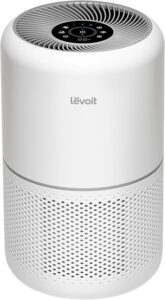
Levoit Core 300S
The Core 300S covers up to 219 sq ft and runs at 24 dB on its lowest setting, making it practical for continuous overnight use in a bedroom. True HEPA filtration captures dust mite allergen particles and the fine debris that carries them. For dust allergy management specifically, the auto-dim sleep mode is a useful feature: the indicator light goes dark when the room does, removing a common reason people turn small purifiers off at night. Continuous overnight operation is where the unit earns its keep for dust allergy sufferers.
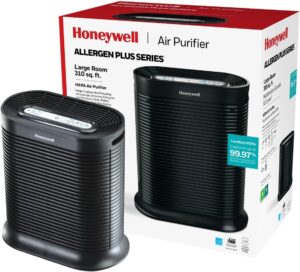
Honeywell HPA200
The HPA200 covers up to 310 sq ft with a strong CADR rating for dust specifically. For a larger bedroom or a living room where a sofa and armchair are the primary dust mite sources, its higher coverage and air exchange rate means more complete particle capture across the full room volume compared to the Core 300S. The tradeoff is noise at 35 dB on low, which suits people who sleep with background sound but may not work for light sleepers. As a daytime living room unit it is a strong performer for the price.
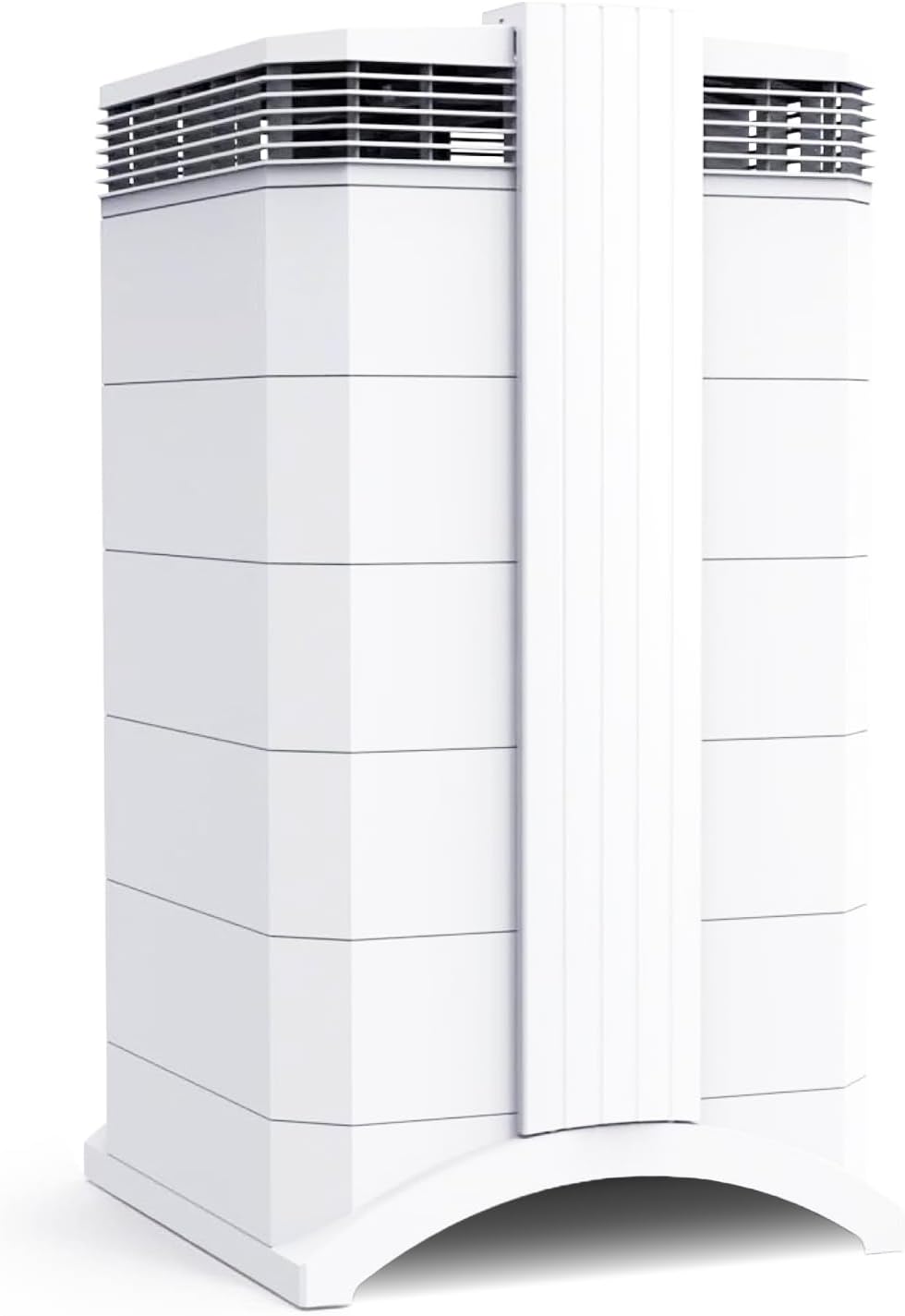
IQAir HealthPro Plus XE
For people with diagnosed severe dust mite allergy or asthma triggered by dust allergens, the IQAir’s HyperHEPA filtration captures particles down to 0.003 microns, well below the 0.3 micron threshold of standard HEPA. Dust mite allergen particles range from around 1 to 40 microns, so standard HEPA captures them, but the IQAir’s margin of performance is meaningful for people who need the cleanest possible air. Its 1,125 sq ft coverage means it operates at very low fan speed in a standard bedroom, producing just 17 dB, quieter than most budget units on their lowest setting.
Frequently Asked Questions
Does vacuuming make dust allergies worse before it makes them better?
It can, temporarily. Standard vacuuming disturbs settled allergen particles and, if the vacuum does not have HEPA filtration, exhausts some of them back into the air. Symptoms can spike for an hour or two after vacuuming in an affected room. Using a HEPA-filtered vacuum reduces this effect significantly. Running the air purifier on a higher speed during and after vacuuming helps clear the disturbed particles faster. If you are highly sensitive, vacuuming when you can leave the room for an hour afterward is a practical workaround.
Can I reduce dust mite allergen without replacing my mattress?
Yes. An allergen-proof mattress encasement seals the existing mite population inside the mattress and prevents their allergen particles from reaching the sleeping surface, regardless of how long the mattress has been in use or how colonized it is. You do not need a new mattress, you need a tight-weave encasement rated to block particles of 10 microns or smaller. Paired with a HEPA air purifier running overnight, this combination significantly reduces the allergen load in the breathing zone during sleep without requiring any new furniture.
How is dust allergy different from seasonal pollen allergy?
Dust mite allergy is year-round rather than seasonal because mite populations are sustained by indoor conditions that do not change with the season. Pollen allergy follows an outdoor season, typically spring through early fall depending on the plants involved, and symptoms improve when windows stay closed during high pollen periods. Dust mite allergy often worsens in winter when heating systems dry the air less effectively and people spend more time indoors. Some people have both, which makes it harder to identify which allergen is driving symptoms at any given time without testing.