Managing Pet Odors in the Living Room
The living room is where pet odor concentrates most and where visitors notice it first. Sprays and candles mask the smell without removing it. Here is what actually works.
The living room is where pet odor builds up fastest. It is where pets sleep, play, and spend the majority of their time indoors, and where the combination of soft furnishings, limited air circulation, and sustained animal presence creates the conditions for persistent smell. Pet owners often adapt to the odor over time through normal olfactory desensitization, but visitors notice it immediately upon entering the home.
The smell has multiple sources that each require a different approach. Dander and skin oils absorbed into upholstery and carpet, saliva from grooming and play, volatile organic compounds produced by the animal’s body, and in dog households, the residue from outdoor activity tracked inside all contribute to the overall odor profile. Addressing one source while ignoring the others produces limited results, which is why single-solution approaches tend to disappoint.
Why Living Room Odor Is Persistent
Soft furnishings are highly effective odor absorbers. Upholstered sofas, armchairs, area rugs, and curtains trap gaseous odor compounds and hold them for extended periods. Every time the pet occupies the sofa, additional compounds are deposited into the fabric. Every time someone sits down, airflow disturbs the surface and releases a portion back into the room. Without active filtration or regular deep cleaning, this cycle continues indefinitely regardless of how often you open the windows.
The living room also tends to have a lower air exchange rate than kitchens or bathrooms, which means odor compounds accumulate faster than they naturally dissipate. In homes where windows stay closed for heating or cooling reasons, there is no natural ventilation to dilute airborne molecules. HVAC systems can spread odor from the living room to other parts of the house during each cycle, which is why a pet odor that seems localized often ends up detectable throughout the home.
Why air fresheners do not solve the problem
Sprays, plug-ins, and candles add a competing scent to the air without removing the underlying odor compounds. Some products contain chemicals that temporarily reduce olfactory sensitivity, creating the impression that the smell has cleared. Neither approach removes the dander, oils, or volatile compounds that produce pet odor. In households with allergy sufferers, fragrance-based products can also trigger symptoms of their own. The reliable approaches are source removal through cleaning and air filtration with activated carbon to capture gaseous odor compounds.
Reducing Pet Odor at the Source
Deep cleaning soft furnishings regularly is the most impactful surface-level step. Steam cleaning upholstered furniture and area rugs removes embedded dander, oils, and odor compounds that surface-level vacuuming cannot reach. Washing slipcovers, throw blankets, and any fabric the pet contacts regularly at high temperatures keeps the primary deposit points from accumulating indefinitely. If the pet has a dedicated bed or blanket, washing it weekly rather than monthly makes a measurable difference in baseline living room odor.
Hard surfaces that pets contact regularly, including floors around the pet’s eating and sleeping areas, should be cleaned with an enzyme-based cleaner rather than a standard household cleaner. Enzyme cleaners break down the organic compounds in saliva, urine, and body oils at a molecular level rather than simply lifting them off the surface. Standard cleaners move the material around; enzyme cleaners eliminate it.
Grooming the pet regularly, ideally outdoors or in an easy-to-clean space rather than the living room, reduces how much dander and loose hair is deposited into living room surfaces during brushing sessions. Bathing dogs on a regular schedule reduces the accumulation of body oils in their coat that contribute to the characteristic dog smell that embeds in upholstery over time.
Using Air Filtration to Remove Living Room Odor
Surface cleaning handles the deposited fraction of pet odor. Air filtration handles the airborne fraction, which is where activated carbon becomes essential. HEPA filtration captures particles including dander, but it does not capture gaseous molecules, which are the primary carriers of odor. An air purifier with a substantial activated carbon layer does both: the HEPA layer removes dander and particulates, and the carbon layer adsorbs volatile odor compounds from the air as they pass through.
For living room use, coverage area matters more than in a bedroom because living rooms tend to be larger and less sealed than bedrooms. A unit rated for roughly the actual square footage of the living room running continuously on a medium setting provides more consistent odor control than a small unit running on high. Positioning the purifier centrally in the room or near the pet’s primary resting area, rather than in a corner, improves how evenly it draws air from across the space.
Recommended Air Purifiers for Living Room Pet Odor
For full specs, pricing detail, and side-by-side comparisons, see the main pets and odors guide. The three options below are the picks most suited to living room odor control specifically.
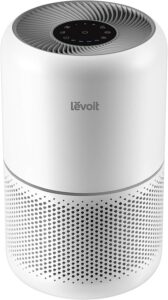
Levoit Core 300P
The Core 300P is best suited to smaller living rooms up to 219 sq ft. The pet-specific filter includes a thicker carbon layer than the standard Core 300, which improves odor capture relative to the price point. For larger living rooms it will need to run on a higher speed setting to keep pace, which increases noise. A practical starting option for smaller spaces or for households looking to try air filtration before committing to a larger unit.
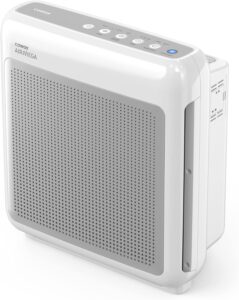
Coway Airmega 200M
The Airmega 200M is the most practical mid-range option for living room odor because its auto mode responds to changes in air quality as they happen. When the pet settles into the room after outdoor activity, or when guests arrive and the room fills with movement that stirs deposited dander, the sensor detects the increase and adjusts fan speed without any manual input. The 360 sq ft coverage handles most standard living rooms comfortably at medium speed.

Rabbit Air MinusA2
The MinusA2 covers up to 700 sq ft and is the only unit in this comparison that can handle a large or open-plan living area as a single unit. For living room odor specifically, the Odor Remover customizable filter panel is worth selecting during purchase. It adds an additional layer of activated carbon and odor-specific media on top of the standard filtration stages, which produces noticeably better odor control than HEPA plus standard carbon alone. The unit can be wall-mounted to keep floor space clear in a furnished living room.
Frequently Asked Questions
How long does it take for an air purifier to reduce pet odor in a living room?
Most people notice a reduction in airborne odor within a few hours of running the purifier on a medium or high setting. The more persistent improvement in baseline odor takes longer, typically several days to a week of continuous operation, as the unit progressively removes the airborne fraction of odor compounds that have been accumulating in the room. Deep cleaning upholstered furniture at the same time significantly speeds up the overall improvement.
Should the air purifier run all the time or only when the pet is in the room?
Continuous operation at a low or medium speed is substantially more effective than running the unit only when the pet is present. Odor compounds and dander particles remain in the air and absorbed into soft surfaces for hours after the pet leaves the room. A purifier running continuously maintains a consistently lower concentration of airborne odor compounds rather than allowing them to build up and then reacting after the fact.
Does the type of pet affect which purifier is the best fit?
For most households with one or two cats or dogs, any of the three picks above will produce a meaningful improvement. Multi-pet households, or those with larger dogs that spend significant time on upholstered furniture, tend to benefit more from a higher-coverage unit with a larger carbon load. The Rabbit Air’s Odor Remover filter option is particularly well suited to households where odor is a more significant concern than particle allergens specifically.