Quiet Air Purifier Solutions for Better Sleep
In a bedroom, noise level at the lowest fan speed matters more than CADR. A purifier that sounds like a hair dryer on low does not get used overnight. Here is how to find one that actually stays on.
Air purifiers for bedrooms face a constraint that purifiers for other rooms do not: they need to run for eight hours continuously while someone is sleeping nearby. A unit that cleans air effectively but produces noticeable noise on its lowest setting will get turned off before bed or after the first night, which eliminates all the benefit of having it. Noise level at low speed is the specification that determines whether a bedroom purifier actually gets used consistently.
The air purifier industry reports noise levels inconsistently, which makes comparison difficult. Some manufacturers report noise on their highest speed, which sounds impressive but is irrelevant for overnight use. Others measure at distances that do not reflect how most people position a purifier in a bedroom. The useful number is decibels at the lowest fan speed, measured at a stated distance, and that is what the comparisons below focus on.
Understanding Noise Levels in Practice
The decibel scale is logarithmic, which means a 10 dB difference represents a tenfold change in sound intensity rather than a simple 10 percent increase. In practical bedroom terms, a unit at 20 dB is roughly as audible as a very quiet whisper and is effectively inaudible to most sleepers. A unit at 30 dB is comparable to a quiet library or a soft background hum that most people adjust to within a night or two. A unit at 40 dB is noticeably audible in a quiet bedroom and will affect sleep for people who are sensitive to background noise.
The threshold that most sleep-sensitive people find acceptable is at or below 30 dB on the lowest speed. Units at 24-25 dB are effectively silent for the vast majority of people. The Rabbit Air MinusA2 at 20.8 dB and the IQAir HealthPro Plus XE at 17 dB on their lowest settings are in the near-inaudible range. Units in the 35 dB range, like the Honeywell HPA200, are better suited to people who already sleep with a fan or other background sound where the purifier blends in.
The coverage area trick that makes purifiers quieter
A purifier rated for a larger room than your bedroom does not need to work as hard to maintain the same air quality, which means it can run at a lower fan speed, and lower noise, than a unit rated exactly for your room size. This is one of the strongest arguments for choosing a mid-range or premium unit with higher coverage capacity for bedroom use: the Rabbit Air MinusA2’s 700 sq ft coverage in a 200 sq ft bedroom means it runs at a fraction of its capacity, producing both minimal noise and longer filter life. The quietest setting on an oversized unit is genuinely quieter than the same fan speed on an appropriately sized one.
Features That Matter for Sleep-Specific Use
Indicator lights are a frequently overlooked issue. Many air purifiers have bright LED status lights, air quality rings, or color-changing indicators that are useful during the day but become a genuine sleep disruption in a dark bedroom. Units with auto-dim or sleep mode features that turn off indicator lights when the room is dark solve this problem without requiring tape over the display.
Auto mode is useful for overnight operation because it adjusts fan speed in response to detected particle levels without requiring manual intervention. If allergen levels spike during the night due to movement in bedding, auto mode responds and returns to low speed when levels drop. For light sleepers, a unit that suddenly ramps up to high speed in response to a detected spike can itself be disruptive, so units with gradual speed transitions are preferable to those that switch abruptly.
Scheduling, available on smart-enabled models like the Levoit Core 300S-P, allows you to pre-set a higher speed for the hour before bed when you want to quickly clear accumulated particles, then automatically step down to the quietest setting for the duration of sleep. This produces the best of both results, an effective pre-sleep clean and silent overnight filtration, without any manual adjustment.
Recommended Quiet Air Purifiers for the Bedroom
For the full comparison including coverage areas and filter costs, see the main sleep and bedroom air guide.
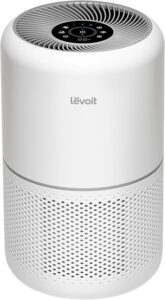
Levoit Core 300S
The Core 300S runs at 24 dB on its lowest setting, quiet enough for most people to sleep through without noticing. The auto-dim sleep mode turns off the indicator light when the room darkens, which addresses the most common complaint about budget purifiers in bedrooms. For rooms up to 219 sq ft it cleans air effectively on low speed. The SP version adds scheduling so you can pre-run the unit at high speed before bed and have it drop to silent low automatically once you are asleep.
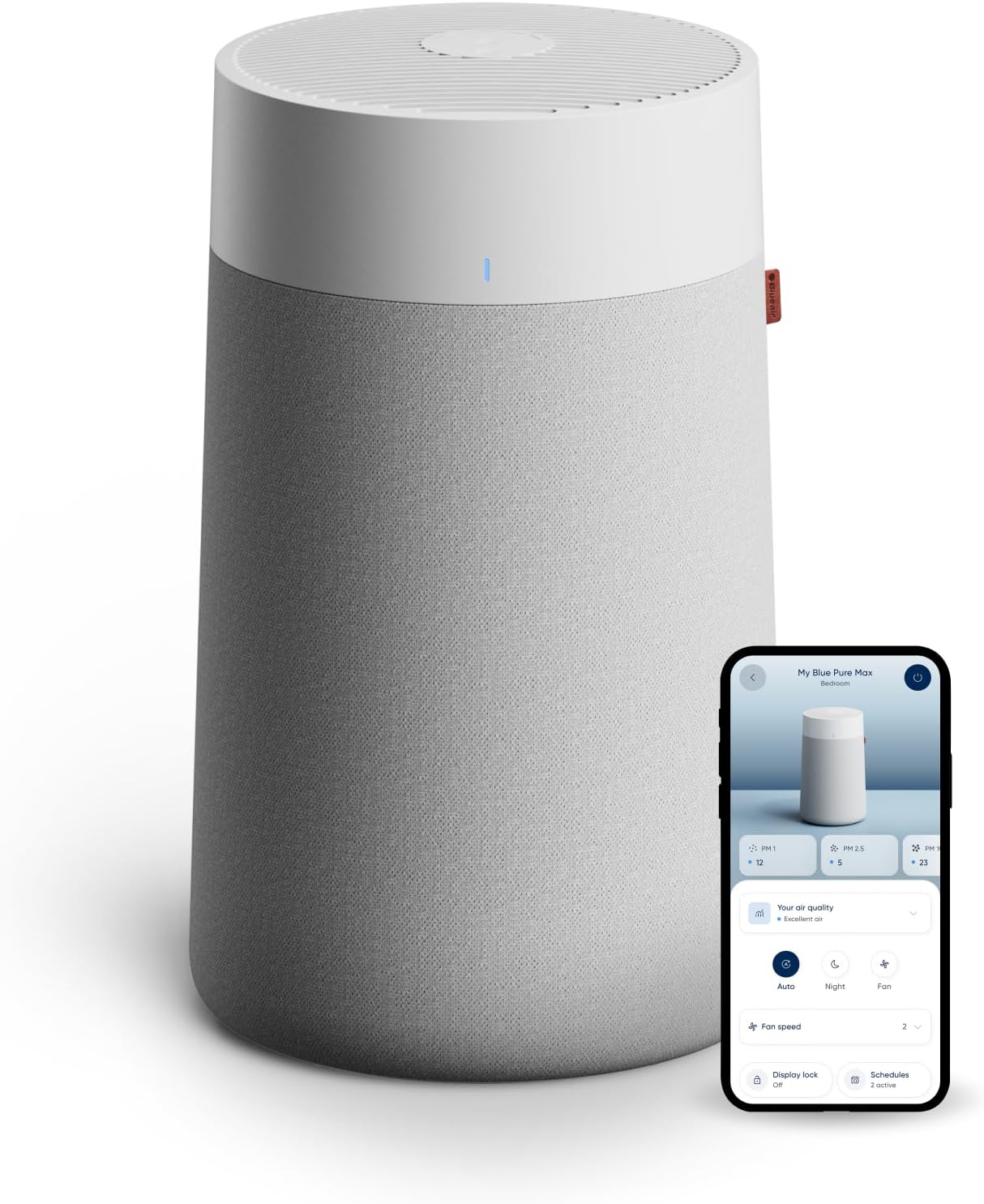
Blueair Blue Pure 311 Auto
The Blue Pure 311 Auto covers up to 388 sq ft at around 24 dB on its lowest setting, making it one of the quietest mid-range options available. The auto mode responds to air quality changes overnight without manual adjustment, and the fabric pre-filter is washable, which reduces ongoing costs for a unit running continuously in the bedroom. For larger bedrooms where the Core 300S would need to run at a higher, noisier speed, the 311 provides more headroom to stay on low speed throughout the night.

Rabbit Air MinusA2
The MinusA2 at 20.8 dB on its lowest setting is the quietest unit at the premium tier and among the quietest air purifiers in any category. Its 700 sq ft coverage means it runs well below capacity in a typical bedroom, producing near-inaudible noise while maintaining thorough air filtration. For light sleepers or anyone whose previous experience with bedroom air purifiers ended with turning the unit off due to noise, the MinusA2 is the option most likely to stay on overnight consistently. The wall-mount option also keeps the unit’s airflow directed away from the bed, avoiding any sense of draft.
Frequently Asked Questions
Is white noise from an air purifier helpful or harmful for sleep?
For many people, the consistent low-frequency hum of an air purifier running on low actually improves sleep by masking intermittent sounds like traffic, voices, or a partner’s movements that are more disruptive than continuous background noise. Whether this is helpful depends on the individual. People who prefer silence tend to do better with a unit at 20-24 dB that is essentially inaudible. People who already sleep with a fan often find units in the 28-35 dB range comfortable and welcome the consistent background sound.
How close to the bed should the purifier be placed?
Close enough to clean the air in the breathing zone effectively, but not so close that airflow from the intake or outlet is directed toward the sleeper’s face. A distance of two to four feet from the head of the bed, positioned to the side rather than directly in front, is a practical starting point. Wall-mounted units like the Rabbit Air MinusA2 solve the positioning problem by keeping the unit at head height on the wall with airflow directed along the room rather than toward the bed.
Does a quieter purifier mean less effective filtration?
Not if the unit is appropriately sized or oversized for the room. A quieter fan speed on a higher-capacity unit moves the same or more air volume per hour than a louder lower-capacity unit running at full speed. The MinusA2 at its quietest setting in a standard bedroom moves more air per hour than a budget unit at full speed. Quiet and effective are not in tension when the unit’s coverage capacity matches or exceeds the room size.