Best Air Purifiers for Small Homes and Apartments (2026)
Small spaces concentrate air problems faster and leave less room for oversized equipment. This guide covers the purifiers that fit apartment living, compact enough to work in tight layouts, effective enough to handle a full open-plan floor.
Our Top Picks at a Glance
Air quality problems in small homes and apartments feel different from those in larger houses, and not just in degree. When all your living happens in 500 to 900 square feet, a single source of poor air quality, a cooking session, a neighbor's cigarette smoke seeping through a shared wall, or dust from old carpet, affects every part of your space. There are no other rooms to retreat to while the air clears.
That constraint cuts both ways. A smaller total volume of air is also faster to clean. A well-matched purifier running continuously in a one-bedroom apartment can turn over the air meaningfully more often per hour than the same unit in a large house. The key is matching the unit to how you actually use the space, not to the largest possible square footage claim on the box.
What to Look for in a Small-Home Air Purifier
Coverage area is the starting point, but it requires some interpretation. Manufacturers calculate coverage area at two air changes per hour, which is a relatively low standard. For meaningful air quality improvement, especially in apartments where you are cooking, running a shower, or living in the space all day, aim for a unit that covers your square footage at four or more air changes per hour. That means choosing a unit rated for roughly twice your actual room size, or running a correctly sized unit on medium rather than low.
Footprint matters in small spaces in a way it does not in a house with a spare bedroom. A large tower purifier that makes sense in a suburban living room can feel intrusive in a studio or a small one-bedroom. All three picks in this guide have compact or medium footprints relative to their coverage area, which is part of why they are well suited to apartment living.
Noise at low and medium speeds is worth checking if you spend most of your time working from home or sleeping in the same space where the purifier runs. In an apartment, there is rarely a room to close off the unit into. It needs to be quiet enough to be unobtrusive at the speed it runs during your daily life, not just on its lowest setting.
Auto-sensing is more useful in an apartment than in other contexts. Cooking, cleaning products, guests, and opened windows all cause quick air quality fluctuations in small spaces. A unit with a particle or VOC sensor that adjusts automatically responds to those changes without you having to monitor and adjust manually throughout the day.
Comparison at a Glance
| Model | Tier | Coverage | CADR | True HEPA | Auto Mode | Price | Link |
|---|---|---|---|---|---|---|---|
| Levoit Core 300S | Budget | 219 sq ft | 145 CFM | Yes | SP only | ~$100 (S) / ~$200 (SP) | Amazon |
| Blueair Blue Pure 311 Auto | Mid-Range | 388 sq ft | 200 CFM | HEPASilent | Yes | ~$350 | Amazon |
| Coway Airmega 400S | Premium | 1,560 sq ft | 350 CFM | Yes | Yes | ~$650 | Amazon |
Why apartments benefit from a slightly oversized unit
A unit rated for twice your apartment's square footage is not wasteful, it is strategic. It runs on lower, quieter fan speeds to maintain the same air quality, extends filter life by working less hard, and has headroom to respond quickly when cooking or other activity spikes particle levels. The Blueair's 388 sq ft rating and the Coway's 1,560 sq ft rating both leave room to run quieter in typical apartments while still turning over the air effectively. For studio and one-bedroom apartments, the Blueair hits this balance well. For two-bedrooms and open-plan layouts, the Coway makes the case.
Our Picks, Reviewed
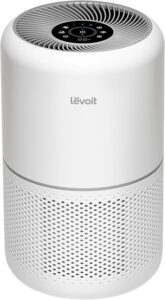
Levoit Core 300S
Best for: Studios, single rooms, and renters who want a capable unit with a minimal footprint and do not need to cover more than one space at a time.
The Core 300S is the right starting point for renters and first-time buyers who want to improve air quality in a single room without spending more than necessary. Its compact cylindrical design takes up less floor space than almost anything else at this performance level, which matters when your living room doubles as your office and you are already short on surface area. At 219 sq ft coverage, it is best understood as a per-room unit: the bedroom when you sleep, the living area during the day, moved between as needed.
The Amazon listing opens on the Core 300S-P at around $200, which adds Wi-Fi, app control, and scheduling. For apartment use, the SP's scheduling is genuinely practical: you can run the unit on high for an hour before you get home from work, then have it drop to quiet low speed by the time you walk in. If those features are not a priority, select the standard Core 300S on the same product page for around $100. Filtration and noise performance are identical between the two, the only difference is connectivity.
Strengths
- Smallest footprint in this comparison
- 24 dB on low, quiet enough for overnight use
- Under $100 for the standard version
- Easy to move between rooms as needed
Limitations
- 219 sq ft covers one room, not an open-plan apartment
- Auto mode only on the SP version at $200
- Needs to be repositioned to cover different rooms
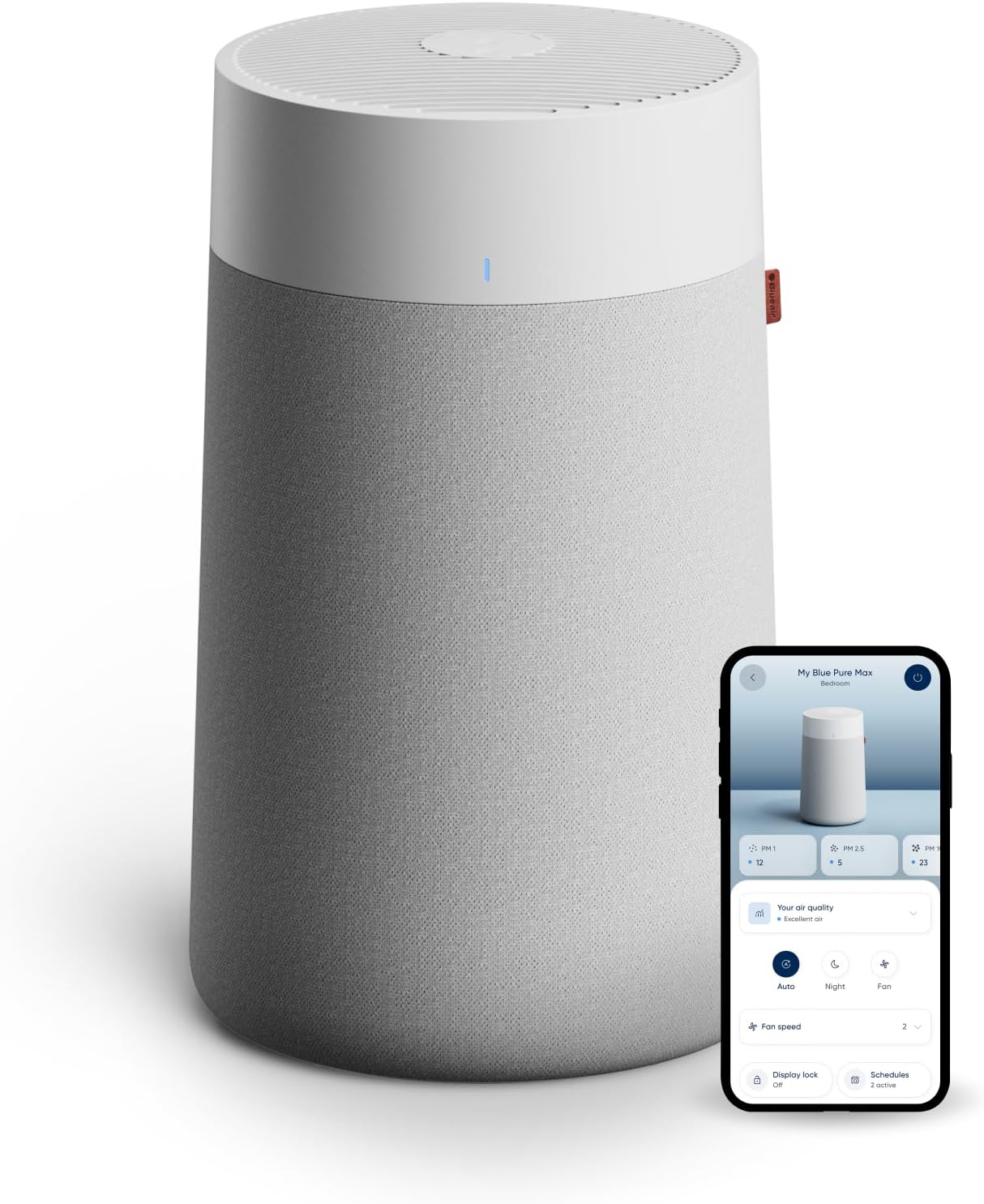
Blueair Blue Pure 311 Auto
Best for: One-bedroom apartments and studio layouts up to 400 sq ft where the unit stays in one place and needs to handle everything from cooking odors to allergens without manual adjustment.
The 311 Auto is well suited to apartment living for a specific reason: its auto mode responds to the kinds of rapid air quality shifts that are normal in small spaces. When you cook, the particle sensor detects the change and ramps up fan speed automatically. When the air clears, it drops back to quiet low speed. In a house you might close the kitchen door and let a range hood manage cooking air. In an open-plan apartment, you do not have that option, and a purifier that adjusts in real time is more useful than one you have to remember to turn up and down yourself.
Blueair's HEPASilent filtration combines electrostatic charging with mechanical filtration, which achieves comparable particle capture to standard HEPA while requiring less fan effort. That translates to quieter operation at a given airflow level, 23 dB on the lowest setting, which is perceptible in a silent room but not disruptive in a normal apartment environment. Coverage of 388 sq ft handles most one-bedroom apartments and larger studios without the unit needing to work at high speed during normal conditions. The washable fabric pre-filter is a minor differentiator that reduces how often you need to replace the main filter, which adds up over a multi-year ownership period.
Strengths
- Auto mode handles cooking and activity spikes hands-free
- 23 dB on low is genuinely unobtrusive
- Covers realistic one-bedroom apartment square footage
- Washable pre-filter reduces ongoing filter costs
Limitations
- No app or smart home integration
- 388 sq ft is tight for two-bedroom apartments
- HEPASilent is not identical to True HEPA certification
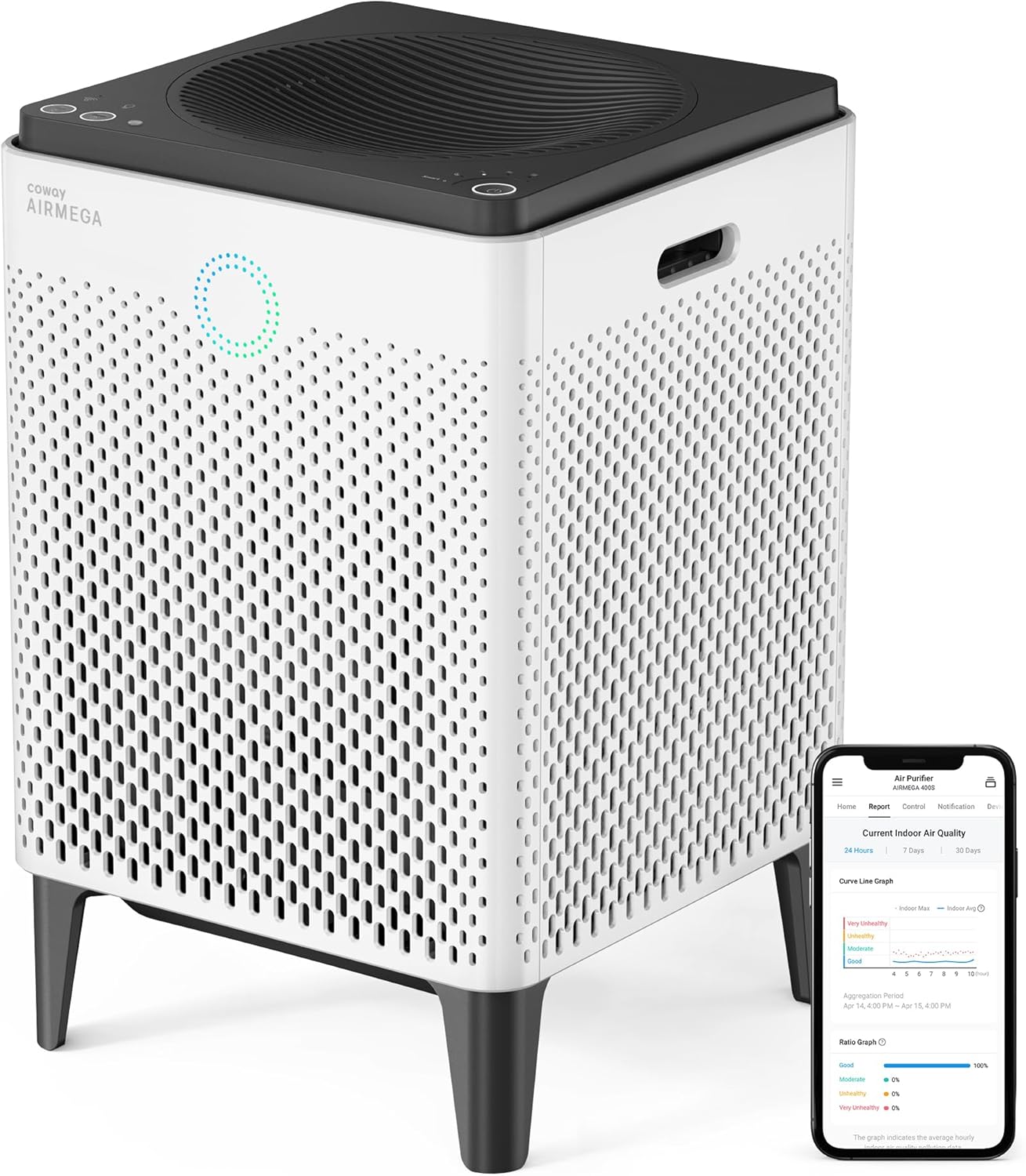
Coway Airmega 400S
Best for: Two-bedroom apartments, open-plan layouts, and small homes where one centrally placed unit needs to cover the full living area and then some.
The Coway Airmega 400S is the unit for people who want to stop thinking about room-by-room coverage and have one purifier handle the whole apartment. Its 1,560 sq ft coverage area is far beyond what most apartments require, and that is exactly the point. In a 700 sq ft two-bedroom apartment, the 400S can deliver eight or more air changes per hour while running on a medium fan speed. That means quieter operation, longer filter life, and consistent clean air throughout the space without the unit ever needing to push to its upper range under normal conditions.
The dual-inlet design pulls air from both sides of the unit rather than a single intake, which improves coverage distribution in open floor plans. Air drawn in from multiple directions creates a more even cleaning pattern across a large room rather than a column of cleaned air close to the unit and less-treated air further away. For apartments where the kitchen, dining area, and living room share a single connected space, this matters more than the coverage number alone.
The Smart Mode connects to the Coway app and integrates with Alexa and Google Home for households already using smart home ecosystems. The real-time air quality display shows indoor and outdoor conditions side by side, which is useful for deciding when to run the unit harder versus when ambient outdoor air quality is actually clean enough to crack a window. At 22 dB on its lowest speed, it stays unobtrusive during everyday use and is quiet enough for a bedroom if the apartment layout requires it to do double duty.
Strengths
- 1,560 sq ft covers whole apartments at low fan speed
- Dual-inlet distributes cleaned air more evenly
- Real-time indoor and outdoor AQI display
- Smart home integration with Alexa and Google Home
- 350 CADR, highest in this comparison
Limitations
- Larger footprint than the other two picks
- $650 is a meaningful investment for apartment living
- Overkill for studios and small one-bedrooms
How to Set Up an Air Purifier in a Small Home or Apartment
Central placement in the main living area is the most effective starting position for a single unit. In an open-plan apartment, the point furthest from walls and corners, such as near the sofa or in the middle of the room, distributes cleaned air most evenly. Units placed in corners or tight against furniture have reduced intake airflow and clean a smaller effective area than their rated coverage suggests.
If your apartment has a separate bedroom and you are using a single unit, position it in whichever space you spend the most time. For most people that is the living area during the day and the bedroom at night, which means either moving the unit or accepting that one space gets less coverage. The Core 300S is light enough to move between rooms easily. The Blueair and Coway are better suited to staying in one position and covering a larger zone.
Cooking is the biggest acute air quality event in most apartments. If your kitchen is open to the living area, run the purifier on a higher speed setting during and for thirty minutes after cooking rather than relying on the range hood alone. The Blueair's auto mode handles this without manual adjustment. For the Core 300S or the Coway on manual, forming the habit of turning it up when you start cooking makes a meaningful difference in particle levels during one of the highest-exposure moments of the day.
Shared air from neighboring units is a real but limited problem. A running HEPA purifier maintains positive air pressure in the immediate vicinity of the unit, which can slightly reduce infiltration from gaps around doors and shared walls. It is not a complete solution for heavy secondhand smoke from adjacent units, but it meaningfully reduces the particle load from minor seepage. For apartments with chronic neighbor smoke issues, the Coway's higher CADR and continuous auto operation are the most practical available response short of building management intervention.
Frequently Asked Questions
Can one air purifier cover a whole apartment?
It depends on the layout and the unit. The Coway Airmega 400S at 1,560 sq ft coverage can handle most two-bedroom apartments as a single unit if the layout is reasonably open. The Blueair at 388 sq ft works for studios and one-bedrooms. The Core 300S at 219 sq ft is best understood as a per-room unit. For apartments with separate bedrooms and closed doors, one unit in the main living area and a smaller unit in the bedroom is often the most practical approach.
Are air purifiers worth it in apartments with shared HVAC?
Yes. Shared HVAC systems can pull air from common areas and other units, which means the building's air quality issues become yours. A portable HEPA purifier operates independently of the building's HVAC and filters whatever air it draws through its intake, regardless of where that air originated. It cannot replace a well-maintained building system, but it meaningfully improves the air quality in your immediate living space regardless of what the building system is doing.
How do I reduce cooking smells and smoke in an open-plan apartment?
The most effective combination is a range hood that vents outside (not a recirculating hood) and a purifier with activated carbon running during and after cooking. If your range hood recirculates rather than vents, it is filtering some particles but releasing heat and moisture back into the apartment without removing odors. A purifier with a real activated carbon layer handles the gaseous odor components that HEPA alone does not capture. The Blueair and Coway both carry enough carbon to make a noticeable difference for cooking odors.
What is the best air purifier for a studio apartment?
The Blueair Blue Pure 311 Auto is the most practical choice for most studio apartments. Its 388 sq ft coverage handles the full space in most studios, its auto mode responds to the rapid air changes that happen in a single-room living situation, and its compact footprint does not dominate a small space. The Core 300S is appropriate for very small studios or anyone primarily concerned with the bedroom portion of the space.
Do I need to worry about ozone from air purifiers?
Only if you are considering an ionizer or ozone generator. True HEPA purifiers with activated carbon do not produce ozone as a byproduct. Some ionizers and UV-C purifiers do generate trace amounts of ozone, which can be an irritant in small, enclosed spaces. All three picks in this guide are HEPA-based and do not generate ozone. If a purifier's marketing emphasizes ionization, plasma, or ozone-generating UV-C technology, that is worth researching further before purchasing for an enclosed apartment.
Quick Buyer Checklist
Four questions to find the right unit for your apartment
1. What is your apartment size and layout? Studio or one room at a time points to the Core 300S. One-bedroom or open studio up to 400 sq ft points to the Blueair. Two-bedroom or open-plan apartment where you want one unit to cover everything points to the Coway.
2. Do you cook frequently in an open kitchen? If yes, prioritize auto-sensing. The Blueair's built-in sensor responds to cooking particle spikes automatically. The Coway's Smart Mode does the same with additional app visibility. The Core 300S requires manual adjustment during cooking.
3. Is your apartment rented? Renters who move regularly benefit from the Core 300S's portability and lower upfront cost. The Blueair is a reasonable mid-range investment for renters in a stable situation. The Coway makes more financial sense if you plan to stay in the same apartment for three or more years or own the space.
4. Do you have allergies, pets, or both? If yes, move up one tier from where apartment size alone would suggest. The additional filtration capacity makes a more noticeable difference when allergen or pet dander load is consistently higher than a typical apartment.
Related Situations
Air Quality with Pets in Small Homes and Apartments
Smaller spaces concentrate pet dander and odor faster, with fewer rooms to dilute the problem. The right approach is different from a larger home, and getting it wrong means the whole apartment feels like the issue.
Living with pets in a small home or apartment presents a more concentrated version of the air quality challenges that pet owners in larger houses face. In a 600 square foot apartment, there are no extra rooms for dander to disperse into, no distant hallways to dilute odor before it reaches the bedroom, and no spare bathroom to use as a grooming station that does not also affect the main living space. Everything happens in close proximity, and the air quality consequences of a pet in that environment are felt more immediately and more consistently.
The good news is that the same concentration that makes the problem more noticeable also makes it faster to address. A smaller total volume of air is quicker to clean with the right purifier. The key is matching the unit and placement strategy to how the space actually works rather than applying solutions designed for larger homes.
Why Small Spaces Amplify Pet Air Quality Problems
In a house with multiple rooms, dander shed by a pet in the living room has the opportunity to disperse across a larger total air volume before reaching the bedroom. In a one-bedroom apartment, the living room and bedroom are often connected by a short hallway or a single open doorway, and dander moves between them freely during normal household air circulation. The bedroom effectively gets the same air as the room where the pet spends most of its time, regardless of whether the pet is allowed in the bedroom.
Odor concentration follows the same pattern. In a larger home, cooking smells, pet odor, and other airborne compounds have more total air to dissipate into. In a studio or one-bedroom apartment, those compounds reach noticeable concentrations faster and stay detectable longer. Visitors often notice the smell of a pet in an apartment more acutely than they would in a larger house, simply because the ratio of pet-generated odor compounds to total air volume is higher.
The case for running one slightly oversized unit rather than two small ones
In a small apartment, a single mid-range unit with enough coverage to handle the whole space running continuously often outperforms two small budget units placed in separate rooms. Two small units require two filter replacement cycles, two power sources, and twice the management, while a single properly sized unit draws air from the whole space through one filtration system. For studios and one-bedroom apartments, the Coway Airmega 200M at 360 sq ft coverage positioned centrally covers most of the space from one placement point.
Placement Strategy for Small Spaces
In an open-plan apartment or studio, central placement in the main living area is the most effective starting point. A unit positioned near the pet’s primary resting area, typically the sofa or a pet bed, draws in the highest concentration of dander and odor at the source before it has a chance to disperse further. Avoid placement in corners or against walls, where reduced airflow on the intake side limits how much of the room the unit can draw from.
For apartments with a separate bedroom and a concern about overnight allergen exposure, placing the purifier in the bedroom at night and the main living area during the day is a reasonable strategy if you only have one unit. The Core 300P is light enough to move between rooms easily. The Coway and Rabbit Air units are better suited to staying in one position and handling a larger zone from there.
Renters should note that wall mounting, which the Rabbit Air MinusA2 supports, typically requires landlord approval. In most cases a floor-standing unit is the practical default. The compact footprint of the Core 300P is a genuine advantage in apartments where floor space is already limited.
Cleaning Habits That Matter More in Small Spaces
Because particles accumulate faster in a smaller air volume, the cleaning frequency that keeps a larger home manageable may not be sufficient in an apartment with pets. Vacuuming with a HEPA-equipped vacuum two to three times per week rather than once keeps the surface dander load from building to the point where everyday movement and air circulation keeps it continuously suspended. Washing pet bedding and any throws or blankets the pet contacts weekly rather than monthly makes a noticeable difference in baseline odor.
Grooming the pet in the bathroom with the door closed and the exhaust fan running, rather than in the living area, keeps the spike in airborne dander from a grooming session contained to an easy-to-clean room rather than distributing it throughout the apartment. The bathroom can be wiped down after grooming in a way that the carpet and upholstery in the living room cannot.
Recommended Air Purifiers for Pets in Small Homes
For full specs and detailed comparisons, see the main pets and odors guide. These three options are particularly well suited to apartment-scale pet households.
Levoit Core 300P
The Core 300P is the right fit for studios under 220 sq ft or for apartment dwellers who want a portable unit they can move between the bedroom and living area as needed. Its compact cylindrical design takes minimal floor space and its 24 dB low-speed noise rating makes it unobtrusive in a small space where the purifier is always within earshot. The pet-specific filter configuration handles both dander and odor at the budget price point.
Coway Airmega 200M
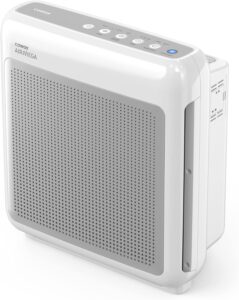
The Airmega 200M is the most practical single-unit solution for a one-bedroom apartment with one or two pets. Its 360 sq ft coverage handles the main living area effectively, and the auto mode responds to dander spikes from pet movement and activity without manual adjustment. The air quality indicator light gives useful real-time feedback on how the apartment’s air is performing throughout the day. Sits comfortably in most apartment layouts without dominating the room.

Rabbit Air MinusA2
The MinusA2 at 700 sq ft coverage is significant overkill for a small studio but makes strong sense for a two-bedroom apartment or a one-bedroom with an open layout where you want one unit to handle the whole space. Running at a lower fan speed than necessary means quieter operation, longer filter life, and headroom to respond quickly when pet activity spikes particle levels. The Pet Allergy filter option is specifically formulated for pet-specific proteins. Wall mounting keeps the floor footprint to zero, which matters in a furnished apartment.
Frequently Asked Questions
Can an air purifier really make a difference in a small apartment with pets?
Yes, and the effect tends to be more noticeable in a smaller space than a larger one precisely because there is less air volume for dander and odor to disperse into. A properly sized HEPA purifier running continuously can turn over the air in a small apartment several times per hour, which keeps airborne particle concentrations consistently low. Most pet owners in apartments who switch to continuous operation notice the difference within a few days, both in terms of smell and, for allergy sufferers, in terms of symptom frequency.
Is one air purifier enough for a one-bedroom apartment with a pet?
For most one-bedroom apartments, a single mid-range unit like the Coway Airmega 200M placed in the main living area covers the space adequately. If the bedroom door stays closed overnight and you want active filtration in both rooms simultaneously, a second smaller unit in the bedroom is worth considering. The Core 300P as a bedroom-only unit paired with the Coway in the living room is a practical two-unit setup that covers both primary spaces without a large total investment.
How do I deal with pet odor in an apartment I am renting?
The most effective renter-friendly approach combines a portable HEPA purifier with activated carbon running continuously, regular vacuuming with a HEPA vacuum, and weekly washing of any fabric the pet contacts. Avoid any permanent modifications. Enzyme-based cleaners handle odor compounds in carpet and upholstery without damaging surfaces or voiding lease agreements. The goal before move-out is to have reduced the embedded odor to a level that standard professional cleaning can address, which continuous air filtration throughout the tenancy makes significantly more achievable.