Best Air Purifiers for Smoke and Wildfire Pollution (2026)
Smoke and wildfire pollution require higher CADR ratings and activated carbon filtration that most everyday purifiers skip. This guide covers the units that hold up during an event, at budget, mid-range, and premium price points.
Our Top Picks at a Glance
Wildfire smoke is a different problem from everyday indoor air quality. The particles are finer, they enter the home faster, they carry combustion byproducts that standard household dust does not, and the exposure window can last days or weeks rather than hours. An air purifier sized for normal daily use will run continuously at maximum speed during a smoke event and still fall short of keeping pace with particle infiltration in anything larger than a single room.
The right purifier for smoke does two things well: it moves a large volume of air through a true HEPA filter quickly, measured by its smoke CADR rating, and it contains enough activated carbon to absorb the gaseous combustion byproducts that give wildfire smoke its distinctive smell and much of its chemical exposure risk. A unit with high CADR but little carbon handles particles and leaves the gases. A unit with carbon but low CADR handles the smell and leaves the particles. Both matter.
What to Look for in a Smoke Air Purifier
CADR stands for Clean Air Delivery Rate, and it is the most useful number for comparing smoke performance across purifiers. It measures how many cubic feet of air per minute the unit cleans of a specific particle type at maximum speed. All three CADR ratings (dust, pollen, smoke) appear on AHAM-certified units. The smoke CADR is the one that matters here, as wildfire smoke particles are the finest and hardest to capture of the three.
As a sizing rule, the EPA recommends matching the smoke CADR to at least two-thirds of the room’s square footage. For a 300 sq ft living room, you want a smoke CADR of at least 200. That is a higher bar than the coverage area claims in most marketing copy, which are typically calculated at lower air change assumptions. During an active smoke event, use the CADR-to-square-footage ratio, not the advertised coverage area, to size your unit.
Activated carbon weight matters more than its presence on the spec sheet. Nearly every purifier includes some activated carbon, but units with only a thin carbon layer or a carbon-coated pre-filter provide a fraction of the odor and gas absorption that a dedicated, thick carbon filter delivers. The IQAir and HPA300 both carry substantially more activated carbon than most units in their price range. The Core 300P’s carbon layer is thinner, appropriate for the price, but limited during extended smoke events.
Filter replacement frequency increases during smoke events. A filter that lasts six to twelve months under normal use may need replacement after two to three months of continuous high-speed operation during wildfire season. Budget accordingly, and check filter status more frequently than the unit’s indicator suggests during heavy smoke periods.
Comparison at a Glance
| Model | Tier | Coverage | Smoke CADR | True HEPA | Carbon Filter | Price | Link |
|---|---|---|---|---|---|---|---|
| Levoit Core 300P | Budget | 219 sq ft | 141 CFM | Yes | Thin layer | ~$100 | Amazon |
| Honeywell HPA300 | Mid-Range | 465 sq ft | 300 CFM | Yes | Dedicated layer | ~$240 | Amazon |
| IQAir HealthPro Plus XE | Premium | 1,125 sq ft | 238 CFM | HyperHEPA | 5 lbs activated carbon | ~$1,200 | Amazon |
Why the IQAir’s CADR is lower than the HPA300’s but it covers more area
CADR measures performance at maximum fan speed, and the IQAir’s six-speed fan delivers 238 CFM at max. But coverage area is calculated at a lower air change rate, and the IQAir’s larger total airflow capacity across its fan speed range handles a bigger room more efficiently over time. The HPA300’s 300 CADR is genuinely impressive for the price and makes it the faster cleaner in a medium-sized room during an acute smoke event. The IQAir’s advantage is the carbon load and the HyperHEPA filtration for ultrafine particles, not raw speed.
Our Picks, Reviewed
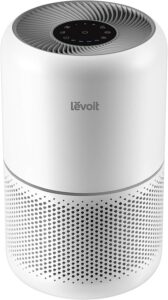
Levoit Core 300P
Best for: Single rooms up to 220 sq ft, renters who need portable protection they can move to whatever room they are occupying, and anyone who wants basic smoke protection without a major outlay.
The Core 300P is not a whole-home smoke solution. It is a single-room unit, and during a wildfire event it should be understood as exactly that: protection for one space where you are spending time, run on its highest setting with the door closed. With a smoke CADR of 141, it can clean the air in a bedroom or small office adequately if the room is sealed and the unit is running continuously.
The pet-specific filter configuration of the Core 300P includes a slightly thicker activated carbon layer than the standard Core 300, which is a marginal advantage for smoke odor absorption. It is not in the same category as the HPA300 or IQAir on carbon capacity, but it is better than a minimal carbon coat. For someone who already owns this unit and encounters an occasional smoke event, running it on high in their bedroom is a reasonable response. As a dedicated smoke purifier, it is best understood as a starter option for small spaces.
Strengths
- Under $100 with true HEPA filtration
- Portable, move it room to room as needed
- Adequate for single sealed rooms during smoke events
- Slightly thicker carbon than standard Core 300
Limitations
- 219 sq ft is too small for living rooms and open plans
- Carbon layer insufficient for extended heavy smoke events
- Single unit cannot protect a whole home
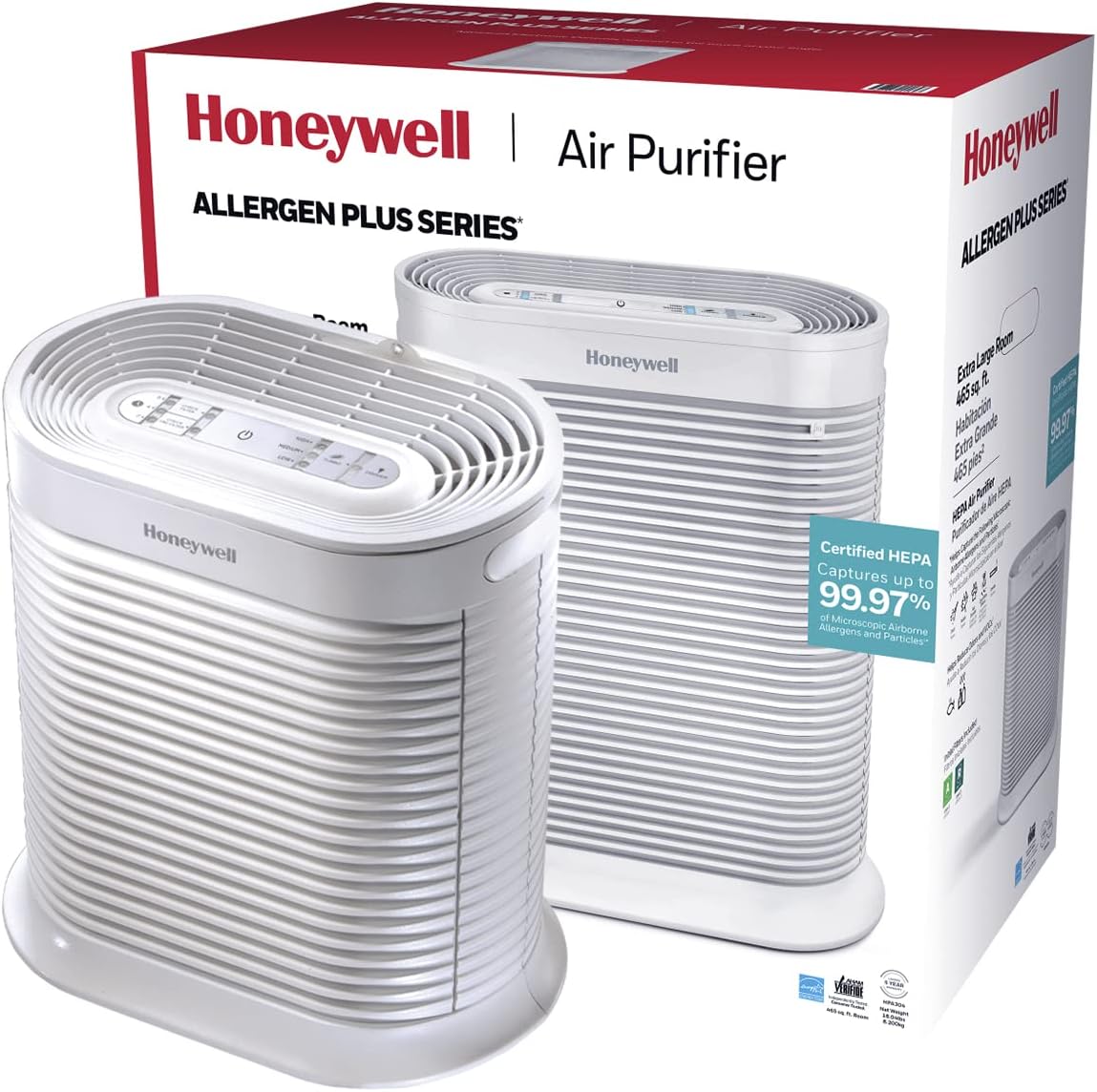
Honeywell HPA300 / HPA304
Best for: Living rooms, large bedrooms, and open-plan spaces up to 465 sq ft. The right choice for most households that want meaningful protection during wildfire season without reaching into premium pricing.
The HPA300 has the highest smoke CADR in this comparison at 300 CFM. That is a meaningful number during an active wildfire event, when you want the unit to cycle through the room’s air as quickly as possible. At 5 air changes per hour in a 465 sq ft room, it turns over the air every twelve minutes on its highest setting. For context, the EPA recommends at least 4-6 air changes per hour during smoke events. The HPA300 meets that standard in a realistic living room.
Four fan speeds give useful granularity. Turbo mode is the right setting during an acute smoke event, and it is loud, around 62 dB. That is acceptable for daytime use but not practical for sleeping. As smoke levels ease, dropping to speed 2 or 3 keeps the room clean with significantly less noise. The unit does not have app control or auto-sensing, which means you are adjusting it manually based on how the air looks and smells outside. For most households, that is a manageable tradeoff for the performance and price.
One availability note: the black HPA300 is intermittently out of stock. The white HPA304 is the same unit with the same filtration and CADR ratings. If the HPA300 listing shows unavailable, the HPA304 is the direct equivalent.
Strengths
- 300 smoke CADR is the highest in this comparison
- Covers 465 sq ft, realistic for living rooms
- Turbo mode cycles air every ~12 minutes during events
- Strong value for smoke-specific performance
Limitations
- Loud on turbo (62 dB), not practical overnight
- No app, auto-sensing, or smart features
- Black version intermittently unavailable
- Carbon capacity lighter than the IQAir for gas absorption
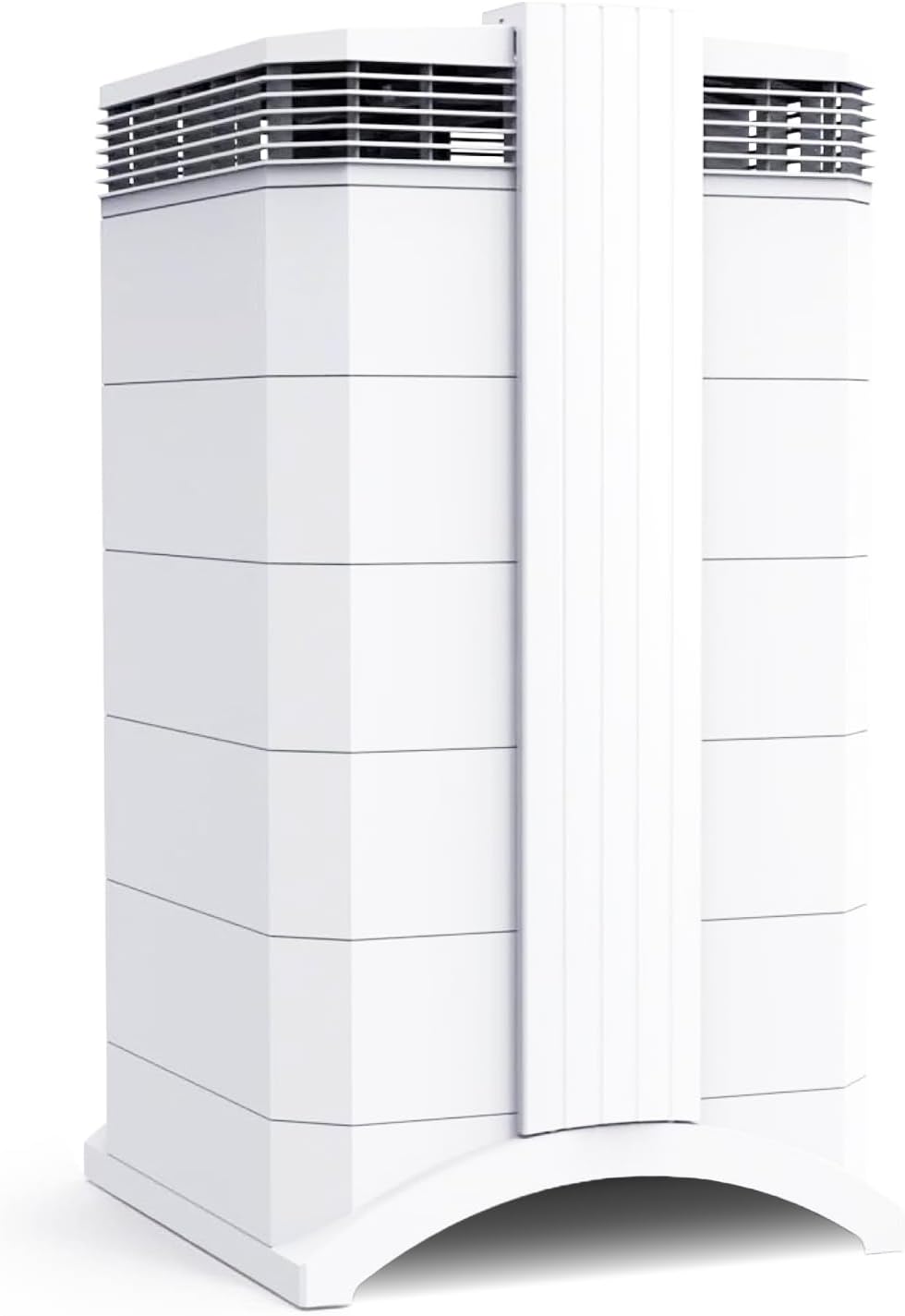
IQAir HealthPro Plus XE
Best for: Households in regions with recurring wildfire exposure, anyone with asthma or serious respiratory conditions, and open floor plans up to 1,125 sq ft that need protection across multiple connected spaces.
The IQAir’s case for smoke and wildfire events rests on two things that no unit in the mid-range can match: HyperHEPA filtration and carbon load. Standard HEPA filters are certified to capture 99.97% of particles at 0.3 microns, which is the particle size that standard HEPA filters capture least efficiently. Wildfire smoke contains particles significantly smaller than 0.3 microns, where standard HEPA filtration is less effective. IQAir’s HyperHEPA is independently certified to capture particles down to 0.003 microns at 99.5% efficiency. For wildfire smoke specifically, that filtration depth is the honest technical argument for the premium price.
The activated carbon stage carries approximately 5 pounds of carbon, far more than any other unit in this comparison. More carbon means more surface area for gas-phase pollutant absorption, which matters for the VOCs, nitrogen oxides, and other combustion byproducts that accompany wildfire smoke particles. The HPA300 will clean the particles faster in a medium room. The IQAir will absorb a greater volume of the gaseous components across a larger space and do so over a longer period before the carbon is exhausted.
Coverage of 1,125 sq ft makes it the only unit here that can meaningfully address an open-plan main floor. Six fan speeds allow quiet overnight use at 17 dB on the lowest setting. IQAir publishes independent third-party test data for all its performance claims, which is worth noting in a category where self-reported specs are the norm.
Strengths
- HyperHEPA captures ultrafine wildfire particles standard HEPA misses
- ~5 lbs carbon handles gas-phase combustion byproducts
- Covers entire open-plan main floors at 1,125 sq ft
- Quiet enough for overnight use at 17 dB on low
- Independent third-party test data
Limitations
- $1,200 is a significant investment
- Replacement filters are expensive
- Lower peak CADR than HPA300 in a medium room
How to Use an Air Purifier During a Smoke Event
Run the unit on its highest setting from the moment outdoor air quality degrades, not after you can smell smoke inside. Particles infiltrate the home before the smell becomes noticeable, and running on high from the start limits how much accumulates before you react. Once the outdoor AQI drops back to a safe level, run the unit for at least a few additional hours to clear particles already inside.
Close all windows, doors, and fireplace dampers. An air purifier in a sealed room is managing a fixed and relatively small amount of incoming air. An air purifier in a room with an open window is fighting an unlimited outdoor source and will lose. Sealing the space is at least as important as the purifier itself.
Focus on the rooms where you spend the most time. A single unit cannot protect a whole house during a heavy smoke event. Prioritize the living room during the day and move the unit to the bedroom at night, or use two units if the household has the budget. The EPA’s Clean Air Room guidance recommends creating a designated cleaner-air space in the home during severe smoke events rather than trying to clean every room at once.
Check your filter more frequently than usual during smoke events. A filter running continuously on high during a multi-week wildfire season accumulates particles far faster than during normal operation. Some units have filter life indicators that underestimate usage during heavy smoke periods. Inspect the filter visually every few weeks during smoke season and replace it when it shows visible discoloration or darkening.
Frequently Asked Questions
Do air purifiers actually help with wildfire smoke?
Yes, with caveats. A true HEPA air purifier running continuously on high in a sealed room meaningfully reduces indoor particle concentration during a smoke event. The EPA and the California Air Resources Board both recommend portable HEPA air purifiers as one of the most effective steps for protecting indoor air quality during wildfires. The unit must be appropriately sized for the room, the room must be reasonably sealed, and the filter must be in good condition. An undersized or clogged unit provides significantly less protection.
What AQI level should I start running my air purifier at?
The EPA’s Air Quality Index considers anything above 100 (the “Unhealthy for Sensitive Groups” threshold) a reason for those with respiratory conditions to stay indoors and limit outdoor activity. Starting your air purifier when the outdoor AQI exceeds 100 is a reasonable baseline. During wildfire events where the AQI spikes quickly, starting at 75-80 gives the unit time to pre-clean the indoor air before infiltration accelerates.
How often do I need to replace filters during wildfire season?
There is no universal answer, but plan for roughly twice the replacement frequency of normal use during an extended smoke event. A filter rated for twelve months of normal use may need replacement after four to six months if it runs on high for several weeks of heavy smoke. Check the filter visually and follow the unit’s indicator, but treat the indicator as a minimum rather than a hard schedule during smoke season.
Can I use a box fan and a furnace filter as a smoke purifier?
The DIY Corsi-Rosenthal box works and has been validated by independent researchers as a reasonable low-cost alternative during smoke events. A 20×20 furnace filter rated MERV-13 or higher taped to the intake side of a box fan captures a meaningful percentage of smoke particles. It is not equivalent to a dedicated HEPA unit, but it is substantially better than nothing and costs around $30. For households that cannot access or afford a dedicated purifier during a smoke event, it is a legitimate interim option.
Is ozone safe during wildfire smoke events?
No. Ozone generators are sometimes marketed as smoke treatment devices, but ozone is itself a respiratory irritant and reacts with VOCs in smoke to produce additional harmful compounds indoors. The EPA specifically recommends against using ozone generators for air purification. Stick to HEPA filtration with activated carbon for smoke events.
Quick Buyer Checklist
Four questions to find the right unit for smoke protection
1. What is the size of your primary space? Under 220 sq ft and the Core 300P covers it in a pinch. Between 220 and 465 sq ft, the HPA300 is the appropriate fit and offers the best CADR-to-price ratio. Over 465 sq ft or an open-plan main floor points to the IQAir or multiple units.
2. How often does your area experience smoke events? If smoke is an occasional inconvenience, the HPA300 is the sensible investment. If you are in a region with recurring multi-week wildfire seasons, the IQAir’s HyperHEPA and carbon load make the long-term case more compelling.
3. Does anyone in the household have asthma or a respiratory condition? If yes, prioritize the IQAir. The ultrafine particle capture and higher carbon capacity are directly relevant to respiratory health outcomes during smoke events, and the price premium reflects a genuine performance difference at that level of sensitivity.
4. Do you need the unit to double as a quiet overnight purifier? The HPA300 is loud on turbo and is primarily a daytime smoke unit. The Core 300P runs quietly enough for overnight use in small rooms. The IQAir handles both at 17 dB on low.