Best Air Purifiers Under $300 (2026)
The short version
For most people, the Levoit Core 300P is the best overall pick for most people: it is the least expensive unit here and runs as low as 24 dB. The Coway Airmega 200M suits a medium living room that needs odor control. The Honeywell HPA5200B suits a larger bedroom and adds an air quality sensor with Auto Mode. The Honeywell HPA300 has the highest CADR and coverage rating in this guide, which makes it the pick for large rooms; during wildfire smoke it is the strongest unit here for a room of about 300 sq ft. For app control and schedules, choose the Levoit Core 300S (sold as the Core 300S-P).
Quick Comparison
| Model | Coverage | CADR (CFM) | App | Best for | Buy |
|---|---|---|---|---|---|
| Core 300P | 222 sq ft | 143 CFM | No | Small rooms, value | Core 300P on Amazon (~$90) |
| Core 300S | 219 sq ft | 141 CFM | Yes (VeSync) | Smart home users | Core 300S on Amazon (~$150) |
| Airmega 200M | 361 sq ft | 246 CFM | No | Pets, odors | |
| HPA5200B | 360 sq ft | 226 CFM | No | Allergies | HPA5200B on Amazon (~$173) |
| HPA300 | 465 sq ft | 300 CFM | No | Large rooms, smoke | HPA300 on Amazon (~$235) |
CADR is the smoke figure where the manufacturer lists several (Coway, Honeywell). Levoit publishes one overall CADR per model. Coverage is each manufacturer’s rating at 4.8 air changes an hour, which does not always match the CADR column exactly: Coway’s 361 sq ft for the Airmega 200M and Honeywell’s 360 for the HPA5200B sit a little above what their smoke CADRs give. AHAM’s two-thirds rule in the FAQ sizes slightly smaller still, about 215 sq ft for 143 CFM.
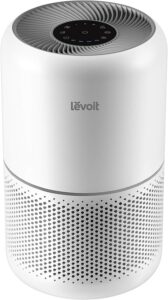
The Core 300P is a compact unit with a published low setting of 24 dB, small enough for a bedroom nightstand. Levoit lists Sleep Mode and a 3-stage filter that pairs a main filter rated at 99.97% down to 0.3 micron with activated carbon. Skip it if you want schedules or phone control; the Core 300S adds those for a higher price.
- Lowest price in this guide
- 24 dB on the lowest setting
- Compact: 8.7 x 8.7 x 14.2 in
- Sleep Mode
- No Wi-Fi or app control
- Rated for rooms of about 222 sq ft
- Louder at maximum than the Core 300S (54.5 dB vs 50 dB)
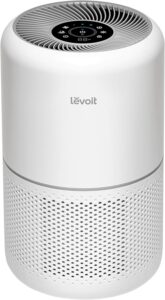
The Core 300S is sold on Amazon as the Core 300S-P. It covers almost the same room size as the Core 300P (219 vs 222 sq ft) and adds the VeSync app with schedules and a timer, plus Alexa and Google Assistant control. Its low setting is 22 dB, 2 dB below the 300P’s. Levoit’s product page does not list an Auto Mode for this model.
- Wi-Fi app control (VeSync)
- Schedules and a 1 to 24 hour timer
- Alexa and Google Assistant support
- 22 dB on the lowest setting, 2 dB below the 300P
- No more coverage than the 300P despite the higher price
- Smart features need a Wi-Fi connection
- No Auto Mode listed by Levoit
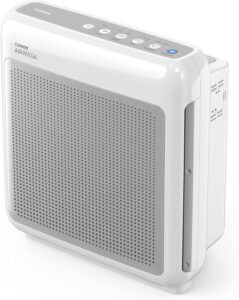
The Airmega 200M is rated for 361 square feet at 4.8 air changes an hour, which suits a medium living room or open-plan studio. Its filter stack pairs a separate deodorization (carbon) filter with True HEPA and a bipolar ion device. Coway lists about 6 months of life for the deodorization filter and about 12 months for the HEPA filter. Auto Mode adjusts fan speed from the unit’s air quality monitoring, and an indicator light, which can be switched off, shows the reading.
- 361 sq ft coverage rating
- Separate deodorization (carbon) filter
- Auto Mode with an air quality indicator light
- Filter indicator for replacement and cleaning
- No app or Wi-Fi control
- Louder at maximum than the Core 300S (55.1 dB vs 50 dB)
- Deodorization filter lasts about 6 months
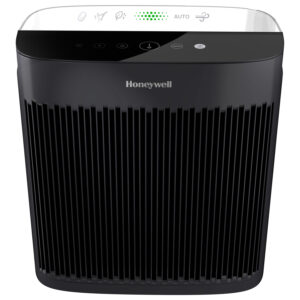
For allergies in a larger bedroom, Honeywell rates the HPA5200B at a pollen CADR of 260 and a smoke CADR of 226 CFM, against the Levoit units’ single overall 141 and 143 CFM. The filter stack is a True HEPA filter plus an activated carbon pre-filter, and an air quality sensor with a green, yellow, and red readout drives the Auto Mode. Honeywell publishes no noise figures; breathequality.com measured 28 dB on low and 60 dB on high. Honeywell lists HEPA replacement every 12 months and the carbon pre-filter every 3 months.
- Pollen CADR of 260, smoke CADR of 226 CFM
- True HEPA filter with a carbon pre-filter
- Air quality sensor with Auto Mode
- AHAM Verifide and ENERGY STAR certified
- 5-year limited warranty
- No app or Wi-Fi control
- Carbon pre-filter replacement every 3 months
- 16.3 lb, heavier than the Levoit units
- Honeywell publishes no noise figures
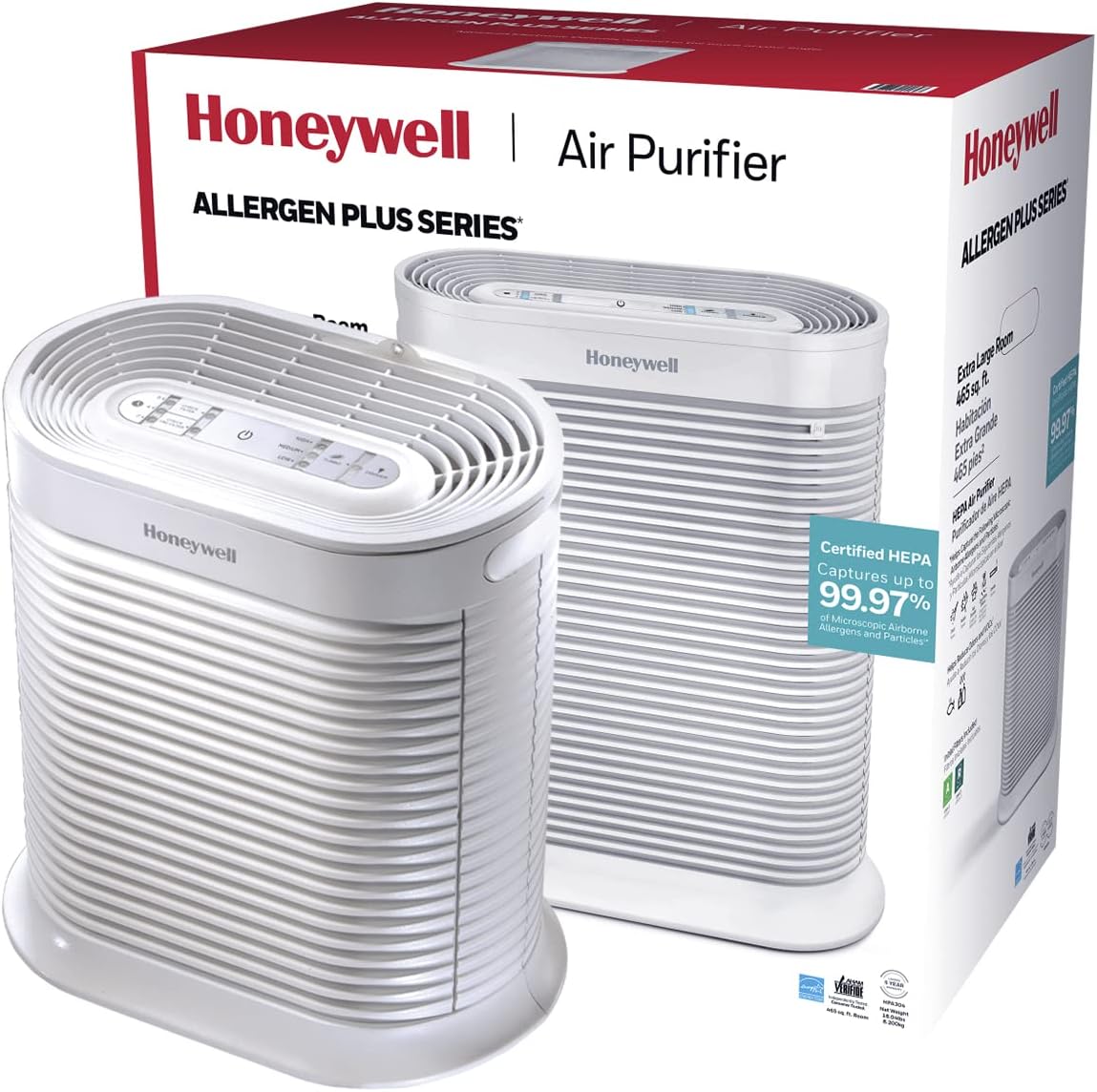
The HPA300 has the largest coverage rating on this list, 465 square feet at 4.8 air changes an hour, which suits open living areas and larger apartments. Its tobacco smoke CADR of 300 CFM is the highest in this guide, ahead of the Airmega 200M’s 246 CFM and the HPA5200B’s 226 CFM, so during wildfire smoke, by AHAM’s floor-area rule in the FAQ below, it covers a room of about 300 sq ft rather than its full 465. It pairs a True HEPA filter with an activated carbon pre-filter. Honeywell publishes no noise figures; Tom’s Guide measured 41 dB on low and 59.6 dB on high.
- 465 sq ft coverage rating
- Tobacco smoke CADR of 300 CFM, the highest here
- 5-year limited warranty
- No smart features or Auto Mode
- Pre-filter replacement every 3 months, HEPA filter every year
- 17 lb, heavier than the HPA5200B’s 16.3 lb
- 41 dB on low (Tom’s Guide), too loud on its lowest setting for many bedrooms