Managing Wildfire Smoke in Apartments
Block the gap under your door to the hallway first, then run a purifier sized for the room where you will spend the event.
In an apartment, part of the building is outside your control: smoke can reach your unit through shared hallways and a shared HVAC system as well as through your own windows. A portable air purifier needs no installation and no landlord approval.
You can seal gaps around your windows. A window or through-wall air conditioner may have an outdoor-air setting; switch it to recirculate, and close the vent or fresh-air damper by hand if it has one. A shared HVAC system that draws outdoor air is outside your control, though building management may be able to switch it to recirculation mode during smoke events.
Apartment-Specific Smoke Entry Points
Put a draft excluder at the door to the hallway. Hallways in apartment buildings are often not sealed from the outside, and smoke that gets into the building through its exterior doors can reach your unit through the gap under yours.
Setting Up a Cleaner Air Room in a Small Apartment
The EPA recommends a cleaner air room during smoke events: one room with windows and doors closed, a portable air cleaner running, and any air conditioner set to recirculate, where you spend as much time as you can. It suggests a room big enough for the household, and a bedroom with an attached bathroom works well. A towel or draft excluder under the door helps, as long as nothing makes it hard to leave the room in an emergency.
Choosing the Right Purifier for Apartment Smoke Protection
For smoke, CADR is the number to size by, because the purifier has to clean the room’s air faster than smoke leaks in. For any room, the cleaner air room included, AHAM’s sizing guideline is a tobacco-smoke CADR of at least two-thirds of the room’s area in square feet. By that rule, a 150 sq ft bedroom needs a smoke CADR of at least 100 CFM and a 400 sq ft living room needs at least 267 CFM.
The Honeywell HPA5300B measures about 19 by 22 by 10 inches and weighs 27 lb, and its smoke CADR of 323 meets AHAM’s guideline for a room up to about 485 sq ft. Measure the spot before you order.
Recommended Air Purifiers for Apartment Smoke
Pick by room: the Core 300P for a bedroom used as the cleaner air room, the HPA5300B for a living room up to about 485 sq ft, and the IQAir when a dedicated gas filter matters more than price. The main smoke and wildfire pollution guide has the full comparison table.
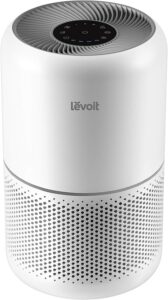
Levoit Core 300P
For a standard bedroom used as the cleaner air room, the Core 300P should be enough, on the rough estimate below. Levoit rates it for 222 sq ft at 4.8 air changes per hour (assuming 8-foot ceilings), with an overall CADR of 143 CFM. Levoit publishes no separate smoke figure, so AHAM’s rule applies only approximately: treated as a smoke CADR, 143 covers about 215 sq ft. Use it as the purifier for your cleaner air room: run it on high with the door closed. Its three-stage filter pairs a main filter Levoit describes as HEPA-grade, rated 99.97% at 0.3 micron, with a high-efficiency activated carbon layer for smoke odor.
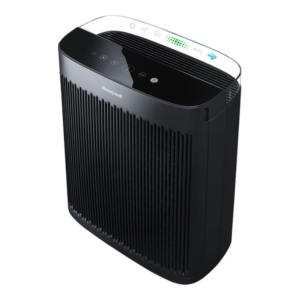
Honeywell HPA5300B
For the living room, with a second unit in the bedroom, the HPA5300B carries a tobacco-smoke CADR of 323 and Honeywell’s 500 sq ft rating at 4.8 air changes per hour. AHAM’s rule allows a room of up to one and a half times the smoke CADR, about 485 sq ft, a little under Honeywell’s 500. Its carbon sits in a pre-filter in front of the True HEPA filters, with no separate carbon bed, and its auto mode runs from a VOC sensor that reads gases, not particles. At 27 lb it is one to place once rather than carry between rooms.
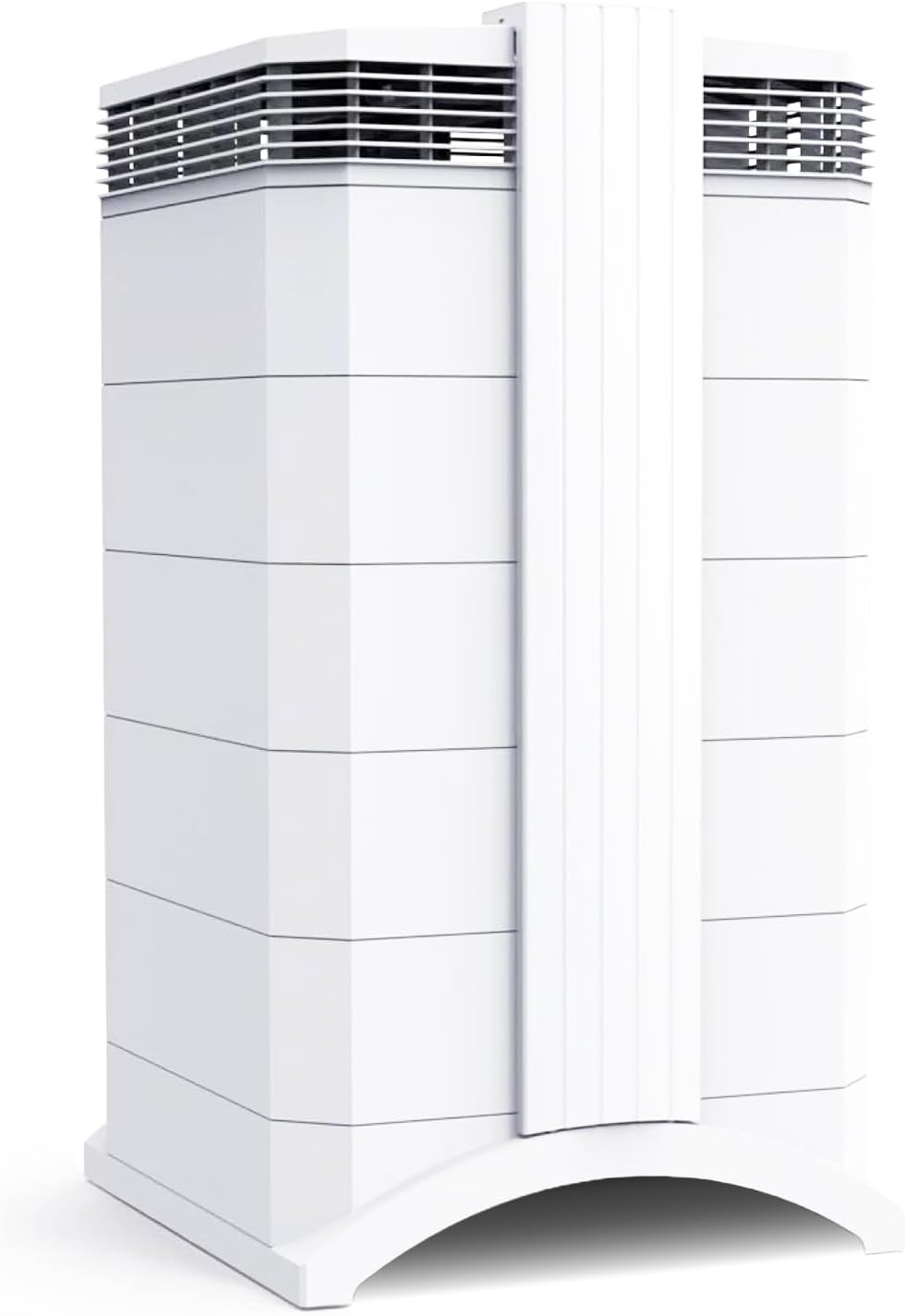
IQAir HealthPro Plus XE
For renters facing smoke events that last for weeks, the IQAir’s draw is its gas stage. The V5-Cell combines granulated activated carbon with impregnated alumina, where the other two picks carry a carbon layer or a carbon pre-filter. IQAir rates its HyperHEPA filter at 99.97 percent at 0.3 microns, the same test point as Levoit’s rating, and at 99.5 percent down to 0.003 microns, and the unit runs at 27 dB on its lowest speed. It is rated for up to 1,125 sq ft, but IQAir publishes neither a CADR nor the air-change rate behind that figure. At its 300 CFM top airflow under an 8 ft ceiling, 1,125 sq ft is at most about two air changes per hour; at the 4.8 rate used for the other picks, even all 300 CFM would cover about 470 sq ft.
Its 3.9 technical score trails the other two mainly on value; filtration scores 5.0 of 5, the highest of the three.
Frequently Asked Questions
Can I ask my building to switch HVAC to recirculation during smoke events?
You can ask. Name the current outdoor AQI and ask whether the system can run in recirculation mode. Whether it can depends on the building; some older systems have no recirculation setting.
Is it safe to open windows briefly to cool down during a smoke event?
The EPA’s cleaner air room guidance is to keep windows and doors closed during a smoke event, since an open window lets smoke straight in. If the apartment gets uncomfortably warm, run an air conditioner set to recirculate, as that same guidance describes. If there is no air conditioning and the heat itself becomes a health concern, contact your local health department about cooling options.
How do I know if my air purifier is keeping up during a heavy smoke event?
Put a portable PM2.5 monitor in the room and compare its reading with the outdoor figure. If indoor PM2.5 is rising toward outdoor levels with the purifier running on high, check the filter first. If the filter is clean, the unit cannot keep up with that room; move to a smaller room and block the gap under its door, keeping the door easy to open.