Austin Air HealthMate Plus Review (2026)
Buy it for a room with a steady VOC or odor source: up to about 120 sq ft on its quiet setting, or about 240 sq ft on high, both worked from dust CADR and likely smaller for smoke. If your problem is mainly dust, pollen or smoke particles, a unit with a higher CADR does more for the money.
A lot of carbon behind a slow fan.
The filter wraps up to 15 lb of carbon and mineral media around 60 sq ft of HEPA, enough to keep adsorbing VOCs long after a thin carbon sheet would saturate. The cost is airflow: on the standard HealthMate, which has the same housing dimensions and three-speed fan, HouseFresh measured a dust CADR of 154 CFM, about what a budget purifier delivers. It scores 3.5 out of 5 on Clear Air Living’s rubric. Filter media earns the full 5.0; value for money and the dial-only controls pull it down.
Specs and Where They Come From
| Spec | Austin Air HealthMate Plus (HM450) | Source |
|---|---|---|
| Price | ~$895 at Sylvane | Sylvane, Nov 17, 2026 |
| Room size at 4.8 ACH | About 240 sq ft on high, 120 on speed 1 (8 ft ceiling, dust CADR) | Worked out from HouseFresh’s CADR |
| Particle CADR | 154 CFM dust; 77 CFM on speed 1 | HouseFresh, standard HealthMate |
| Noise, speeds 1 to 3 | 42.0 / 53.2 / 61.5 dB at 3 ft | HouseFresh, standard HealthMate |
| Power draw | 61 / 85 / 148 W | HouseFresh, standard HealthMate |
| Filter stages | Large-particle pre-filter, medium-particle pre-filter, carbon and mineral media, HEPA | Austin Air |
| Gas-phase media | Up to 15 lb (over 780 cu in) of activated carbon, potassium iodide-impregnated carbon and mineral media | Austin Air |
| HEPA | 60 sq ft, rated 99.97% at 0.3 micron and 99% at 0.1 micron | Austin Air |
| Filter life | Up to 5 years | Austin Air |
| Warranty | 5 years mechanical, 5 years pro-rated filter | Austin Air |
| Controls | 3-speed dial; no sensor, app or filter indicator | Austin Air |
| Size and weight | 14.5 x 14.5 x 23 in, 47 lb, on casters | Austin Air |
| Technical score | 3.5 out of 5 | Clear Air Living |
| Where to buy | HealthMate Plus at Sylvane (~$895) |
Austin Air does not publish a CADR, a noise rating, an airflow figure or a room size for the HealthMate Plus on its own product page, so the performance rows above come from HouseFresh, which bought and lab-tested the standard HealthMate (HM400). Austin Air describes the difference between the two models as the carbon blend, and the housing dimensions and three-speed fan match. A different blend can change airflow slightly, so read the measured figures as approximate for the Plus.
What the Carbon Is For
Gases pass straight through a HEPA filter. Off-gassing from paint and new furniture needs an adsorbent, usually activated carbon, and so do cooking odors and the gas fraction of wildfire smoke. The amount of carbon sets how much gas a filter can hold before it saturates.
The Plus version adds carbon impregnated with potassium iodide, which Austin Air states improves adsorption of specific chemicals such as formaldehyde. Austin Air publishes no formaldehyde removal rate, so the Plus’s added formaldehyde benefit over the standard HealthMate is unquantified.
In HouseFresh’s test of the standard HealthMate, particles cleared within the hour while VOC readings kept falling over the following hours. Leave it on around the clock in a closed room to get the benefit of the carbon.
Particle Performance Is Modest for the Price
With an 8-foot ceiling, 154 CFM cleans a 200 sq ft room about six times an hour. A 300 sq ft room gets about four, under the 4.8 that AHAM uses for its room ratings, so the largest room it holds at 4.8 air changes is about 240 sq ft. AHAM sizes rooms by smoke CADR, which Austin Air does not publish and which usually runs below dust CADR, so for smoke these room sizes are likely optimistic. In HouseFresh’s test room the HealthMate took 52 minutes to bring PM1 to its sensor’s zero reading, against 54 for the budget Levoit Core 300.
Speed 1 is the only setting HouseFresh measured under 45 dB, and there it delivered 77 CFM, about half the top-speed figure. That covers about 120 sq ft at 4.8 air changes an hour, the figure to use for a bedroom.
Where the 1,500 sq ft figure comes from
Several retailer listings describe the HealthMate Plus as covering up to 1,500 sq ft. Austin Air’s own product page gives no room size, and the figure does not hold up against a measured CADR: 154 CFM in a 1,500 sq ft room with an 8-foot ceiling is less than one air change an hour.
Noise, Power and Upkeep
On the standard HealthMate, HouseFresh measured 42.0 dB on speed 1, 53.2 dB on speed 2 and 61.5 dB on speed 3, all from 3 feet. Speed 1 suits a bedroom. Speed 3 is close to the level of normal conversation, loud enough to intrude in a room where you work or sleep. HouseFresh’s power readings on the same unit run from 61 W on speed 1 to 148 W on speed 3; around the clock on top speed, that is about 3.5 kWh a day.
The filter is rated for up to five years and carries a five-year pro-rated warranty. Heavy smoke or chemical load saturates the carbon sooner. Those are the homes this unit suits, so the carbon may run out early, and the unit has no filter-life indicator to warn you. HouseFresh found that a filter swap on the standard HealthMate takes a screwdriver; it didn’t test the Plus. The unit weighs 47 lb on casters and has no sensor, timer or app.
Where to Buy
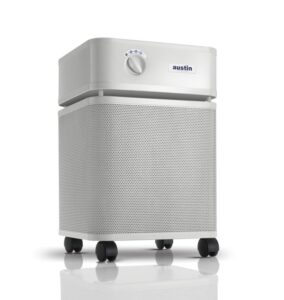
Austin Air HealthMate Plus (HM450)
Austin Air’s own store listed it at the same price as Sylvane on November 17, 2026. At Sylvane the Midnight Blue finish costs more than the other three colors.
Frequently Asked Questions
What is the difference between the HealthMate and the HealthMate Plus?
The potassium iodide-impregnated carbon in the gas stage, which Austin Air says improves adsorption of specific chemicals such as formaldehyde.
Is the HealthMate Plus good for wildfire smoke?
It suits the weeks after a smoke event, when the haze has cleared but the smell lingers indoors. During the event, the fine particles call for a unit with a higher CADR.
How often does the filter need replacing?
With no indicator, watch for the odor coming back; that is the sign the carbon is spent, often before the five-year rating in a smoky or chemical-heavy home.