Best Air Purifiers for Pets (2026)
Three picks for pet dander and odor at three budgets, from a compact bedroom unit to a wall-mountable purifier for multi-pet homes, compared on manufacturer specs.
Our Top Picks at a Glance
Dog and cat dander is light enough to stay airborne and travel between rooms, and it collects in fabrics between vacuumings. Fur and hair create a secondary problem by clogging pre-filters faster than expected, which reduces the performance of the HEPA layer underneath. Then there are the odors: litter boxes, wet coats, bedding, and the general presence of animals in an enclosed space create a gas-phase air quality challenge that particle filtration alone cannot solve.
Each purifier in this guide pairs a HEPA filter for particles with activated carbon for odors, since a pet household needs both. They span three price tiers and three room sizes.
What Makes a Good Air Purifier for Pets
Filtration type comes first. True HEPA filters capture 99.97% of particles at 0.3 microns, which covers pet dander, pollen carried in on fur, and dust mite allergens stirred up by animals moving through the house. Filters labeled “HEPA-type” or “HEPA-style” do not meet the same standard and will let finer dander particles pass through. All three picks use a HEPA-grade main filter.
Activated carbon matters as much for pet owners. HEPA captures particles, but pet odors are volatile organic compounds in the gas phase. Without an activated carbon layer, a purifier will reduce visible dander in the air while doing nothing about the smell of wet dog or a litter box two rooms away. All three picks include dedicated carbon filtration.
Coverage area needs to match where the pet spends time. A unit rated for 200 sq ft does very little when the dog lives on the couch in a 400 sq ft living room. CADR (Clean Air Delivery Rate) is the number to watch: it tells you how much filtered air the unit delivers per minute. Higher CADR means faster air turnover in larger spaces.
Filter replacement runs faster with pets
Manufacturer filter schedules assume typical household use, and pre-filters clog with fur and hair faster in a pet home. Check pre-filters monthly, expect to replace the main filters sooner than the rated interval, more so with several pets or a heavy shedder, and count filter cost alongside the purchase price.
Our Picks, Reviewed
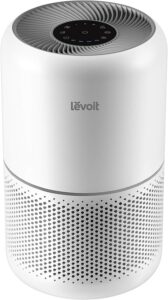
Levoit Core 300P
Best for: One pet in a bedroom or home office, first-time buyers, and renters looking for an affordable starting point.
The Core 300P is the entry point that makes sense for most single-pet households. Its three-stage filtration system pairs a true HEPA layer with activated carbon, so it handles both dander and odors. At 24 dB on the lowest fan speed, it runs quietly enough to leave on overnight in a bedroom where a dog or cat sleeps.
It is rated for 222 sq ft at 4.8 air changes per hour, which defines its role. In a bedroom or home office, it will keep up with one pet comfortably. In a larger living room where the dog spends most of the day, the air exchange rate drops enough that you will notice dander and odors persisting. For the room where you sleep, this is the pick; for living room coverage, look at the mid-range tier.
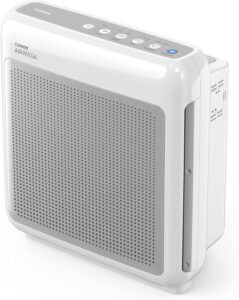
Coway Airmega 200M
Best for: One or two pets in a living room or open bedroom, households where odor is as much a concern as dander, and buyers who want real-time air quality feedback.
The Airmega 200M covers the gap that budget units leave open. Rated for 361 sq ft at 4.8 air changes per hour, with a smoke CADR of 246 CFM, it handles a living room or open-plan bedroom where a pet actually spends most of the day. Its four-stage filtration adds a bipolar ion stage to the pre-filter, True HEPA, and deodorization carbon filter.
The real-time air quality indicator on the front panel is especially useful in a pet household. Dander spikes are invisible, such as when a dog comes in from outside, and the indicator light changes color when the sensor reads more particles. Auto mode adjusts fan speed from those readings, and Eco mode reduces energy use during quiet periods.
For most single-pet or two-pet households, this is the recommendation that covers the widest range of situations. It covers rooms the budget tier cannot, handles dander and odors, and runs at 24.4 dB on its lowest setting.
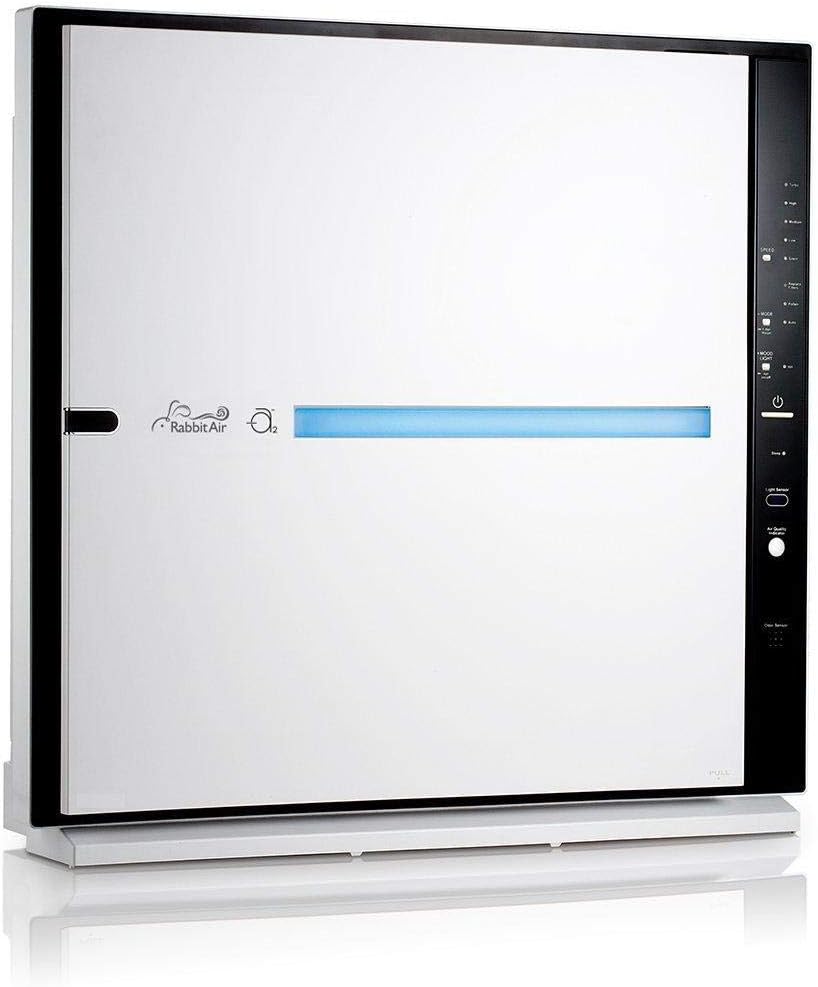
Rabbit Air MinusA2
Best for: Multiple pets, larger open living areas, and anyone who has outgrown a mid-range unit.
The MinusA2 is the serious option for households where pet dander and odor are a daily concern. It is rated for 408 sq ft at 4 air changes per hour, or 815 sq ft at 2, and its six-stage filtration has more stages than any other pick in this guide. The standout feature for pet owners is the customizable filter panel: you select a specialty filter based on your primary concern, and the Pet Allergy panel adds a targeted layer specifically for dander and pet-related allergens.
Wall mounting helps in a pet home. In a home where animals knock over floor-standing objects, or where you need floor space clear for kennels, beds, and food bowls, mounting the unit on the wall removes the purifier from the pet’s reach entirely.
It runs at 25.6 dB on its lowest setting, and its particle and odor sensors raise the fan speed when activity stirs up dander. The SPA-780A version sold through this link has no app; Rabbit Air’s Wi-Fi model is the SPA-780N.
The upfront cost is a significant step up from the mid-range tier. It makes the most sense when a smaller unit cannot keep up with several pets or a large open room.
Placement and Usage for Pet Households
Position the purifier in the room where your pet spends the most waking hours, at least a foot from walls and furniture on all sides. The intake and output need unobstructed airflow to operate at their rated CADR. Tucking a unit behind a couch or in a corner reduces its effective coverage area substantially.
Continuous operation on a low fan speed outperforms short bursts on high. Dander accumulates throughout the day at a steady rate, and consistent low-level filtration keeps total airborne particle concentration lower than cycling the unit on and off. Every purifier in this guide runs quietly enough on its lowest setting to leave on around the clock without being disruptive.
If you have one unit and a pet that moves between rooms, prioritize the bedroom. Sleep is the longest uninterrupted stretch of time you spend in one room. If your budget allows a second unit, add one in the main living area where the pet spends daytime hours.
Reducing Dander Beyond the Purifier
An air purifier handles airborne particles, but dander also settles into surfaces that filtration cannot reach. Cleaning habits cover those surfaces.
Vacuuming carpets and upholstery twice a week with a vacuum that uses its own HEPA filter prevents settled dander from being kicked back into the air during cleaning. Washing pet bedding weekly in hot water removes accumulated allergens from the place where dander concentration is highest. Keeping pets out of the bedroom keeps dander from collecting in bedding; where that is not realistic, run a dedicated purifier in the bedroom continuously.
Grooming pets regularly reduces the volume of loose dander and fur entering the air in the first place. Brushing outdoors when weather permits keeps shed fur and dander from accumulating indoors at all.
Frequently Asked Questions
Do air purifiers remove pet odors or just dander?
Both, if the unit includes an activated carbon filter. True HEPA filtration captures dander and other solid particles, while activated carbon adsorbs the volatile organic compounds that cause pet smells. A purifier with only a HEPA filter will reduce airborne dander but leave odors unchanged. All three picks in this guide include dedicated activated carbon filtration for this reason.
Can one air purifier cover my entire home?
In most cases, no. Air purifiers filter the air in the room they occupy. An open floor plan can sometimes be handled by a single high-CADR unit placed centrally, but any room with a closed door needs its own unit. The Rabbit Air MinusA2, rated for 408 sq ft at 4 air changes per hour, can serve many open living areas, but a bedroom with the door shut requires separate coverage regardless of what is running elsewhere in the house.
How often should I replace filters in a pet household?
Sooner than the manufacturer schedule, which assumes typical household use. Check the pre-filter monthly and clean it by rinsing or vacuuming. A pre-filter clogged with pet hair restricts airflow. Replace the main filter when it looks gray throughout.
Do so-called hypoallergenic breeds produce less dander?
All dogs and cats produce dander regardless of breed. Some breeds shed less hair, which reduces the visible mess, but dander is shed skin, so a low-shedding coat still produces it. A purifier sized to the room is useful regardless of breed.
Should I run the purifier while I am away from home?
Yes. Pets produce dander continuously whether anyone is home or not. Leaving the purifier running on a low setting while you are out prevents particle buildup so you return to cleaner air. The energy cost of continuous low-speed operation is minimal for all three units in this guide.