Ventilation Fan Types: Exhaust vs Air Circulators (2026)
If a room is damp or smells of cooking, you need an exhaust fan that sends the air outdoors. If it only feels warm and still, a circulator is enough, and the Vornado 660 moves the most air per watt on high of any circulator compared here. A whole house that feels stale needs whole-house ventilation.
The Six Fan Types at a Glance
| Fan type | Where the air goes | Use it for | Our guide |
|---|---|---|---|
| Spot exhaust fan (bathroom fan, range hood) | Out of one room, through a duct to the outdoors | Shower moisture and cooking fumes, at the source | Bathroom fans, range hoods |
| Inline fan | Through ductwork; the fan sits in the duct, away from the room | Long duct runs, several rooms on one fan | Duct sizing |
| Supply fan | Outdoor air pushed in; stale air leaks out | Whole-house ventilation; ENERGY STAR files it under hot or mixed climates | Ventilation guide |
| Balanced ventilator (ERV, HRV) | Equal amounts in and out, through a recovery core | Whole-house fresh air in any climate | ERV vs HRV |
| Whole-house fan | In through open windows, out through the attic | Flushing a hot house with cooler evening air | Below |
| Air circulator (floor, table, ceiling fan) | Around the room; nothing leaves the house | Comfort through moving air | Picks below |
Air Circulators vs Exhaust Fans
An exhaust fan removes air: a bathroom fan pushes shower vapor through a duct to the outdoors, and replacement air flows in from the rest of the house. A circulator stirs the air already in the room. Shower vapor and cooking smells stay in the house.
A circulator changes how the room feels. The U.S. Department of Energy says moving air creates a wind chill effect that cools your body, and it counts ceiling, table, floor and wall fans among circulating fans. Because the effect is on your body, the air temperature in the room does not drop, and a fan left running in an empty room cools no one. A circulator also spreads the output of an air purifier or a heating vent across a room.
Damp Bathroom? A Circulator Will Not Fix It
Shower vapor has to leave the house through a fan ducted outdoors. The International Residential Code requires bathroom exhaust to discharge outdoors, never into an attic. Size the fan with our exhaust fan size chart and choose one from our best bathroom exhaust fans.
Exhaust, Supply and Balanced Ventilation
The Department of Energy groups whole-house systems three ways. Exhaust-only systems rely on leakage into the building for fresh air; supply-only systems push outdoor air in and rely on leakage out; balanced systems do both with an exhaust and a fresh-air intake. ENERGY STAR’s ventilation guide pairs them with climates: exhaust systems with cold climates, supply systems with hot or mixed ones, and balanced systems with all climates.
A bathroom fan rated for continuous duty is the cheapest exhaust-only system, and our home ventilation and exhaust fans guide shows how ASHRAE 62.2 lets one count toward the whole-house rate. Balanced systems usually mean an ERV or HRV, which recovers heat from the outgoing air; our fresh air ventilation systems guide compares five.
Inline Fans
The Home Ventilating Institute describes an inline fan as one mounted in the ductwork, away from the room, sometimes called a remote-mounted fan. Multiport versions let one fan serve more than one location, two bathrooms for example, with branch ducts and adjustable grilles setting the rate at each. HVI gives a capacity range from about 100 CFM at the small end up to 2,000 CFM for commercial applications.
Whole-House Fans
A whole-house fan sits in the ceiling below the attic, pulls air in through open windows and exhausts it through the attic and roof. The Department of Energy’s Building America guidance says the windows must be open before the fan runs, with at least 4 sq ft of screened window per 1,000 CFM, and the attic needs at least 1 sq ft of net free vent area per 750 CFM. It cools a house only when the outdoor air is cooler than the indoor air.
Best Air Circulators
Circulators fall outside both ENERGY STAR’s ventilating-fan program and the Department of Energy’s fan test procedure, which covers only air circulating fans drawing 125 watts or more. So the comparison below rests on each maker’s own published airflow and wattage; CFM per watt is our arithmetic from those figures.
| Model | Airflow, high | Watts, high | CFM per watt | Sound, high to low | Warranty | Price | Link |
|---|---|---|---|---|---|---|---|
| Vornado 660 | 1,638 CFM | 53 W | 30.9 | 59 to 43 dBA | 5 years | ~$120 | Vornado 660 at Vornado (~$120) |
| Vornado 630 | 1,122 CFM | 50 W | 22.4 | 54 to 47 dBA | 5 years | ~$80 | Vornado 630 at Vornado (~$80) |
| Vornado 6303DC | 1,051 CFM | 48 W | 21.9 | 59 to 40 dBA | 5 years | ~$150 | Vornado 6303DC at Vornado (~$150) |
| Vornado 133 | 350 CFM | 27 W | 13.0 | 44 to 35 dBA | 5 years | ~$30 | Vornado 133 at Vornado (~$30) |
| Lasko A20301 | 2,026 CFM | 107 W | 18.9 | Not published | 1 year | ~$60 | Not linked |
Prices were read on vornado.com and lasko.com in November 2026; the Lasko figure is its regular, non-sale price.
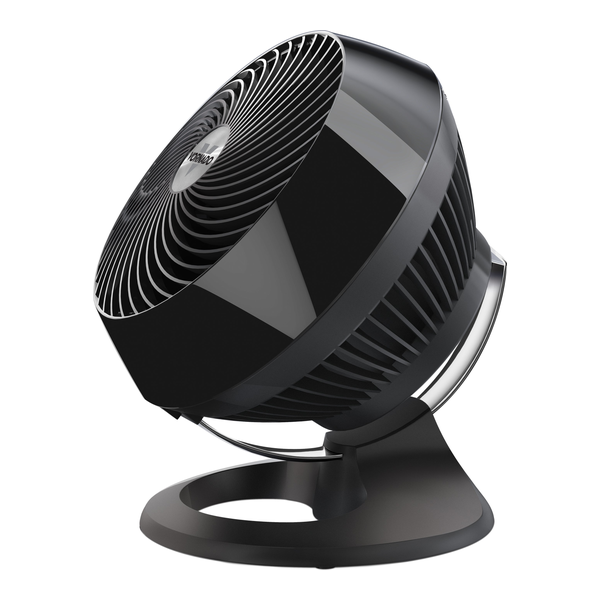
Vornado 660
Best for: A living room, open-plan space or large bedroom where you want air moving at the far wall.
Vornado rates it at 1,638 CFM on high for 53 watts. It throws air a stated 100 feet. On its lowest of four speeds it still moves 663 CFM at 43 dBA on 27 watts, which keeps the low setting usable in a bedroom, though the 133 is quieter at 35 dBA.
The Lasko A20301 moves more air at the top, 2,026 CFM, for about half the price. It draws 107 watts to do it, Lasko publishes no noise figure for it, and its warranty runs one year against the Vornado’s five. At 59 dBA on high the 660 ties the 6303DC as the loudest of the fans with published noise figures.
Strengths
- Highest CFM per watt on high here
- Per-speed airflow, watts and noise published
Limitations
- 59 dBA on high
- No remote or timer
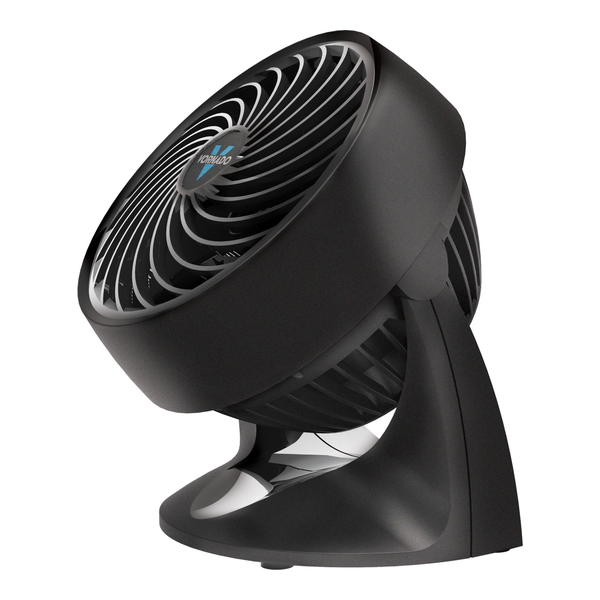
Vornado 133
Best for: A desk, nightstand or dorm room, where the fan sits within a few feet of you.
It moves 350 CFM on high at 44 dBA and 254 CFM on low at 35 dBA, the quietest figure in this guide, from a body under 9 inches tall that weighs 2.1 lb. Vornado states a reach of 25 feet and gives it the same 5-year warranty as the 660.
At 13 CFM per watt it is the least efficient fan in the table, though at 27 watts on high it still draws about half what the 660 does. The Lasko 507 is a near match on airflow at 370 CFM, but Lasko publishes no noise figure for it and its own page gives two different wattages.
Strengths
- 35 dBA on low
- 5-year warranty at the lowest price here
Limitations
- Lowest CFM per watt in the table
- 25-foot reach suits close range only
The Vornado 6303DC adds control: 99 speeds, a remote and a 1 to 12 hour timer, and Vornado lists its low setting at 2 watts. It costs about a quarter more than the 660 and moves about 36% less air on high. The Vornado 630 sits between the 660 and the 133 on airflow at two-thirds of the 660’s price.
Frequently Asked Questions
What fan do I need for a stuffy bedroom?
If the room is warm and still, a circulator such as the Vornado 660 on low or the 133 on a nightstand improves comfort. If it feels stuffy because the door stays closed and fresh air never reaches it, a fan in the room cannot bring any in; whole-house ventilation, or a ductless ventilator for a single room from our fresh air ventilation systems guide, can.
Do whole-house fans work in humid climates?
They can, with limits. A whole-house fan swaps indoor air for outdoor air, moisture included. The Building America guidance says to run it at night when the outdoor air is at least 10°F cooler than the indoor air was during the day, and in humid climates not to run the air conditioner for several hours before or after it, because of condensation.