Home Ventilation and Exhaust Fans Guide (2026)
Size a bathroom exhaust fan at 1 CFM per square foot of floor up to 100 sq ft, and never below 50 CFM. For most bathrooms that points to the Panasonic WhisperCeiling DC FV-0511VQ1, which you set to 50, 80 or 110 CFM at install.
Our Top Picks at a Glance
How Much Exhaust Each Room Needs
| Room | Fan run when the room is in use | Fan run continuously | Source |
|---|---|---|---|
| Bathroom up to 100 sq ft | 1 CFM per sq ft of floor, 50 CFM minimum | 20 CFM | HVI; ASHRAE 62.2 |
| Bathroom over 100 sq ft | 50 CFM per toilet, shower or tub; 100 CFM per jetted tub | 20 CFM | HVI (fixtures); ASHRAE 62.2 (continuous) |
| Kitchen | 100 CFM from a range hood vented outdoors; 300 CFM for other kitchen fans, or 5 air changes per hour in an enclosed kitchen | 5 air changes per hour of kitchen volume, enclosed kitchens only | ASHRAE 62.2 |
With an 8-foot ceiling, the Home Ventilating Institute’s square-foot rule works out to 7.5 air changes an hour.
Compare the Picks
| Model | Tier | Airflow | Sones (HVI rating, 0.1 in. w.g.) | Duct | Install | Price | Link |
|---|---|---|---|---|---|---|---|
| Panasonic FV-0511VQ1 | Mid-Range | 50 / 80 / 110 CFM | Under 0.3 | 4 or 6 in | Ceiling; 7-3/8 in housing | ~$153 | FV-0511VQ1 on Amazon (~$153) |
| Panasonic FV-1115VQ1 | Premium | 110 / 130 / 150 CFM | Under 0.3 | 6 in | Ceiling; 7-3/8 in housing | ~$208 | FV-1115VQ1 on Amazon (~$208) |
| Broan Flex AE80K | Budget | 80 CFM | 0.7 | 4 in | Room side, 2×6 minimum (Broan) | ~$89 | AE80K at Sylvane (~$89) |
An Exhaust Fan and an Air Purifier Do Different Jobs
A portable air purifier pulls room air through a filter and blows it back into the same room. That captures particles, but the water vapor from a shower stays in the room. An exhaust fan pushes air out of the house through a duct, and replacement air flows in from the rest of the home, often through the gap under the door. HVI recommends undercutting bathroom doors for that reason. Shower steam and cooking fumes belong outdoors; smoke particles already spread through the house are a filtration job, covered in our smoke and wildfire purifier guide.
Sizing a Bathroom Fan
Measure the floor, counting the shower and tub area. Up to 100 sq ft under an 8 ft ceiling, the square footage is the CFM you need, with 50 CFM as the floor; above 100 sq ft, count 50 CFM for each toilet, shower and tub. A 40 sq ft hall bath takes the FV-0511VQ1 on its 50 CFM setting, and a large bath with a tub, a separate shower and an open toilet takes the FV-1115VQ1 at 150 CFM. Taller ceilings, enclosed toilet rooms and long duct runs change the number; the exhaust fan size chart covers each.
Long or bent duct runs cut the airflow a fan delivers, so on a long run use smooth or larger duct, or a fan with a 6-inch outlet. Both Panasonic picks use a DC motor that speeds up when it senses static pressure, to hold its set airflow.
Noise: Reading the Sone Rating
Sones measure loudness on a linear scale, so 2 sones sounds twice as loud as 1. ASHRAE 62.2 caps a switched bathroom fan at 3 sones.
Box ratings from HVI are taken at 0.1 inch of static pressure. ENERGY STAR also publishes sound at 0.25 inch, closer to a typical installed duct, and there the FV-1115VQ1 measures 0.7 sones on its 150 CFM setting. Panasonic’s published specifications for the FV-0511VQ1 list 0.4, 0.6 and 0.9 sones at 0.25 inch for its 50, 80 and 110 CFM settings. An installed fan on a long or kinked duct will sound louder than its box rating.
Kitchen Ventilation
ASHRAE 62.2 calls for at least 100 CFM from a range hood when you switch it on, and the hood has to vent outdoors to count. A recirculating hood filters grease and returns the rest of the air to the kitchen. Other switched kitchen exhaust fans, including downdraft units, need 300 CFM. Five air changes an hour of the kitchen’s volume can stand in for the 300, switched or continuous, only in an enclosed kitchen, one whose openings to other rooms total no more than 60 sq ft. Five 30-inch Broan hoods are sized against that rule in our kitchen ventilation guide.
Whole-House Ventilation
Spot fans clear one room when it is in use. A tighter house also needs a steady supply of outdoor air, which ASHRAE 62.2 sizes by floor area and bedroom count. A bathroom fan running continuously can count toward that rate, so work out the whole-house figure first and then choose a fan its maker rates for continuous duty at the share it will cover. In a cold or hot climate, an ERV or HRV brings that air in without losing most of the heating or cooling. Fans that only stir room air, such as air circulators, send nothing outdoors.
The Three Fans in Detail
A shallow-housing Panasonic and a Broan with a humidity sensor and light are in the bathroom fan roundup, each with a technical score.
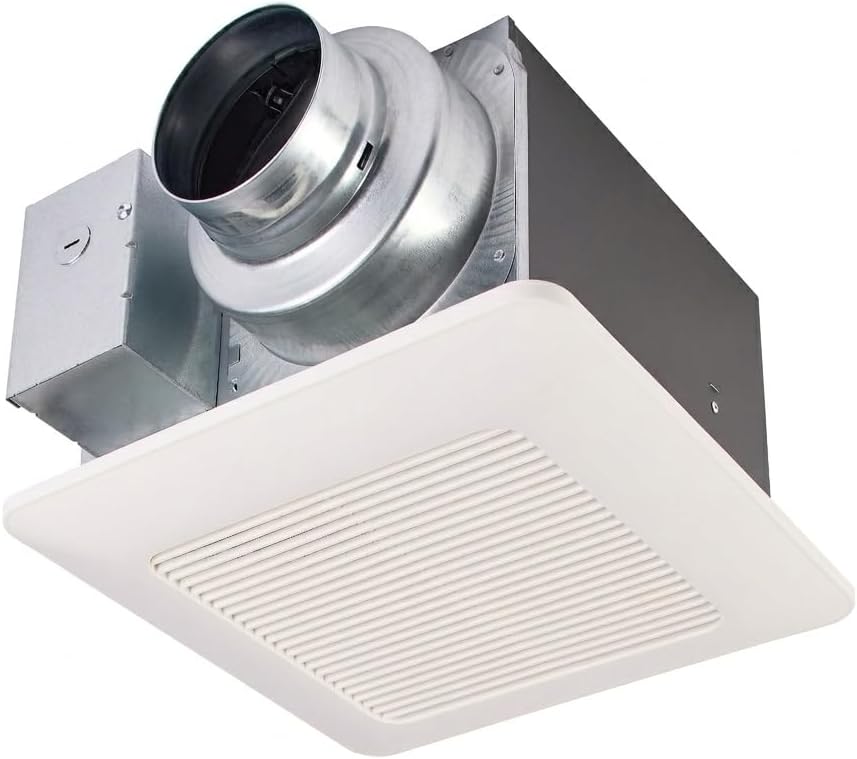
Panasonic WhisperCeiling DC FV-0511VQ1
Best for: Bathrooms up to 100 sq ft with standard 8 ft ceilings.
A switch inside the housing sets the fan to 50, 80 or 110 CFM, so one model covers a powder room or a full bath up to 100 sq ft. In a bath well under 100 sq ft, the top setting leaves headroom for a longer duct. It is rated under 0.3 sones at all three settings and draws 4.0 to 10.6 watts across them. The outlet takes either a 4-inch or a 6-inch duct, so a long run can move up to the larger size.
The housing is 7-3/8 inches deep, so measure the space above the ceiling opening and read Panasonic’s installation sheet for how the housing sits. A 2×6 joist is about 5-1/2 inches deep, shallower than that housing, and Broan lists a 2×6 minimum for the Flex below, which makes the Broan the pick for a 2×6 ceiling.
Strengths
- Three airflow settings in one fan
- Under 0.3 sones at each setting, at 0.1 in. static pressure
- Accepts 4 or 6 in duct
Limitations
- 7-3/8 in housing; measure the ceiling cavity first
- No light, humidity sensor or timer built in
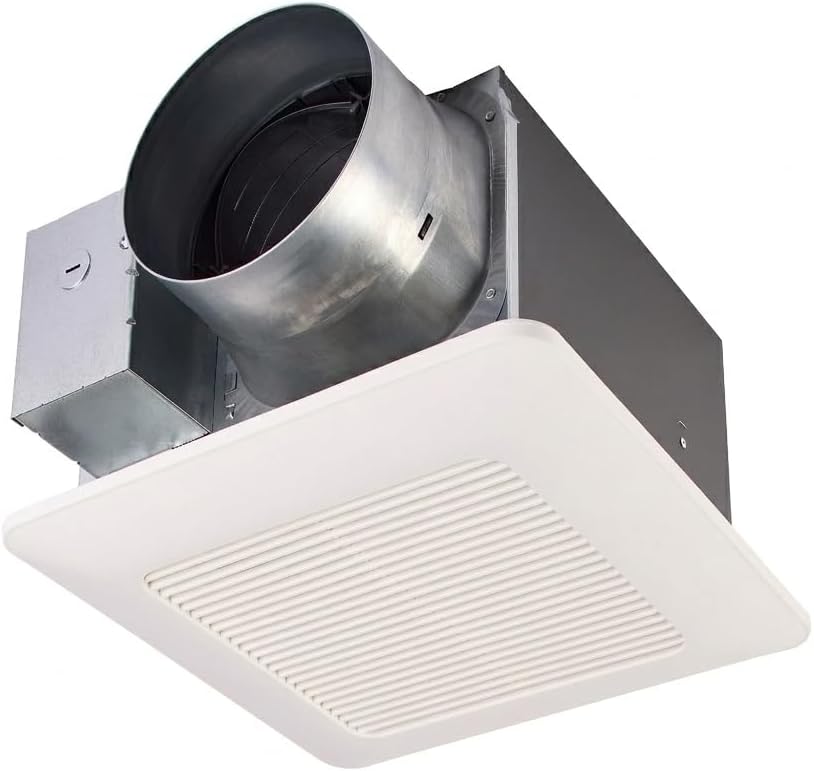
Panasonic WhisperCeiling DC FV-1115VQ1
Best for: Primary baths over 100 sq ft with an open toilet, a tub and a separate shower, where HVI’s fixture count reaches 150 CFM.
Its switch sets 110, 130 or 150 CFM. The 150 CFM setting covers HVI’s three-fixture total with one fan where the toilet is open to the room. Its power draw runs from 6.8 to 11.8 watts across the settings. At 0.25 inch of static pressure, Panasonic lists 0.7 sones on the 150 CFM setting, 0.5 on 130 and under 0.3 on 110. In a home with a natural-draft gas water heater or furnace, check 150 CFM against the ASHRAE limit in the FAQ below.
It takes 6-inch duct only. Replacing a fan that sits on a 4-inch duct means running new duct or adding a reducer, and a reducer brings back the resistance the larger outlet was meant to avoid.
Strengths
- Up to 150 CFM from one fan
- Three settings to match the fixture count
Limitations
- 6 in duct only
- More airflow than a bath under 100 sq ft needs
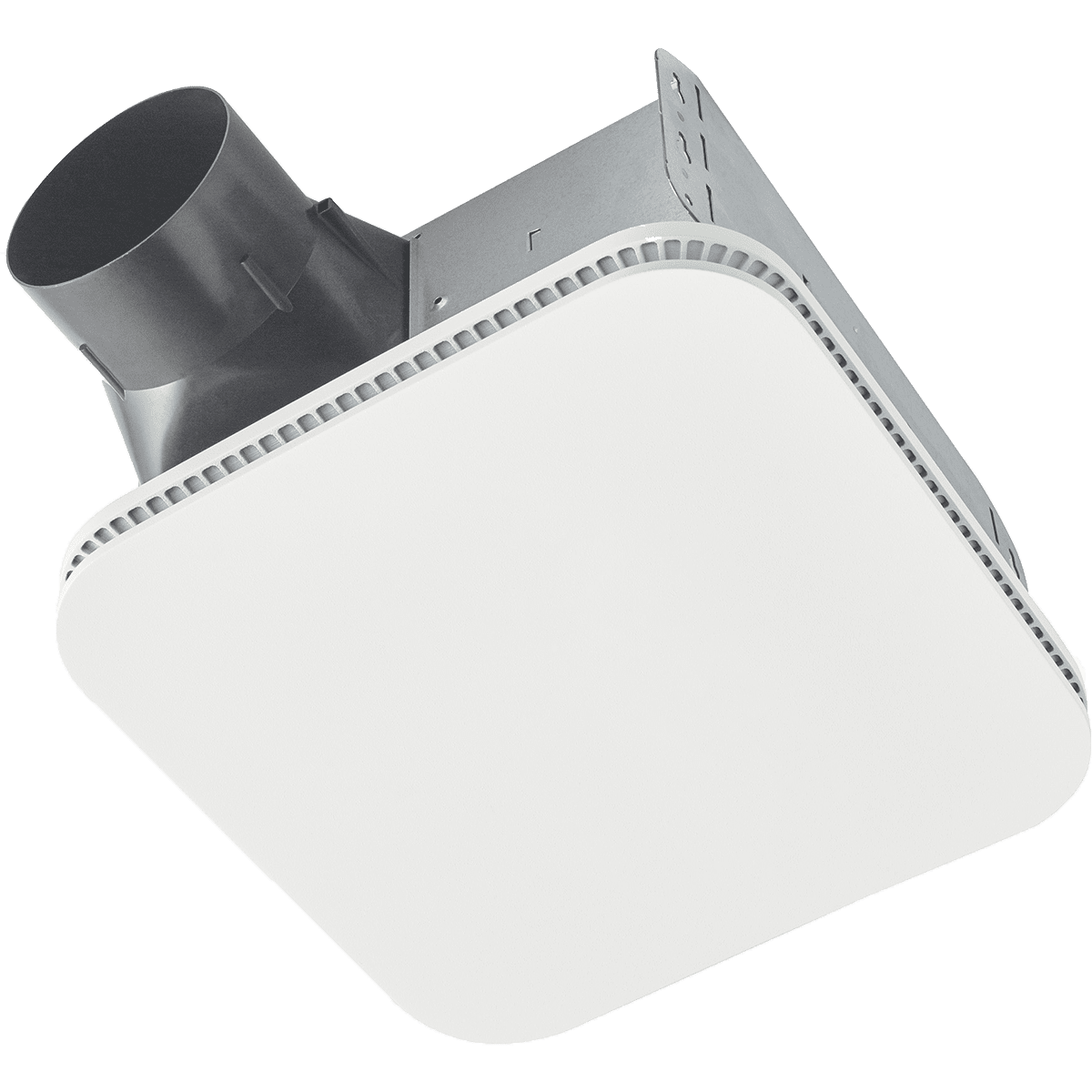
Broan Flex AE80K
Best for: Replacing a fan in a ceiling with no attic above it, in a bathroom up to 75 sq ft.
The Flex series installs entirely from the room side: the housing fits through the ceiling opening and the duct connector attaches from below, so a bathroom under another floor can get a new fan without opening more of the ceiling. Broan lists a 2×6 minimum construction space.
It moves a fixed 80 CFM at 0.7 sones on a 4-inch duct, and Broan recommends it for rooms up to 75 sq ft, a little under the 80 sq ft that HVI’s square-foot rule would give. That 80 CFM is rated at 0.1 inch; a long or bent 4-inch flexible duct will deliver less. Look at the duct through the old fan’s opening before you buy.
Strengths
- Installs without attic access
- Fits 2×6 framing
Limitations
- Single fixed speed
- Broan rates it for rooms up to 75 sq ft
- 4 in duct only
Frequently Asked Questions
What size exhaust fan do I need for my bathroom?
An 80 sq ft bathroom with 8 ft ceilings takes an 80 CFM fan, which is the FV-0511VQ1 on its middle setting. Broan rates its 80 CFM Flex for up to 75 sq ft. Above 100 sq ft, count fixtures as in the sizing section.
Can a bathroom fan be too powerful?
A fan far above the room’s need wastes heated or cooled air and pulls harder on the gap under the door. In a house with a gas water heater or furnace that vents by natural draft, large exhaust flows can pull combustion gases back down the flue. ASHRAE 62.2 addresses this by limiting the combined airflow of the two largest exhaust fans to 15 CFM per 100 sq ft of the home’s floor area in homes with those appliances inside the living space.
How long should a bathroom fan run after a shower?
HVI recommends 20 minutes after the bathroom is used. A timer switch or a humidity-sensing wall control turns the fan off on its own.
Can a bathroom fan vent into the attic?
No. Section M1501.1 of the International Residential Code requires exhaust air to be discharged outdoors and bars exhausting it into an attic, soffit, ridge vent or crawl space. Run the duct to a roof or wall cap.