Fresh Air Ventilation Systems: ERV vs HRV (2026)
If your ducted home needs up to about 105 CFM of steady outdoor air, as a 2,500 sq ft, three-bedroom house does under ASHRAE 62.2, buy the Broan ONE BLP150E75 ERV. That rate leaves it headroom below its 146 CFM top. Bigger houses and very cold winters call for the Broan B210E75R, and a single room with no ducts for the Pioneer ECOasis 150.
Our Top Picks at a Glance
Compare the Ventilators
| Model | Type | Airflow (at 0.4 in. w.g.) | Sensible recovery, 32°F | Sensible recovery, -13°F | Watts at about 64 CFM | Ducts | Price | Link |
|---|---|---|---|---|---|---|---|---|
| Broan ONE BLP150E75 | ERV, ducted | 32 to 146 CFM | 78% at 64 CFM | 36% at 68 CFM (CSA test, not HVI-certified) | 31 W | 6 in | ~$929 | Broan ONE ERV at Sylvane (~$929) |
| Broan B210E75R | ERV, ducted | 65 to 206 CFM | 81% at 64 CFM | 65% at 83 CFM | 28 W | 6 in | ~$1,582 | B210E75R at Sylvane (~$1,582) |
| Broan B130E65R | ERV, ducted | 35 to 119 CFM | 67% at 66 CFM | 56% at 66 CFM | 30 W | 5 in | ~$1,087 | B130E65R at Sylvane (~$1,087) |
| Broan B110H65R | HRV, ducted | 35 to 100 CFM | 68% at 64 CFM | 60% at 64 CFM | 26 W | 5 in | ~$919 | B110H65R at Sylvane (~$919) |
| Pioneer ECOasis 150 | ERV, ductless wall unit | Up to 88 CFM (no static pressure on Pioneer’s product page) | Not comparable: Pioneer lists 82% temperature efficiency with no test point or HVI rating | Not published | Not published at 64 CFM (12.6 to 43.8 W across 8 speeds, per Pioneer’s catalog) | None; two 4 in wall holes | ~$1,088 | ECOasis 150 at Sylvane (~$1,088) |
Recovery figures are Broan’s HVI-certified sensible recovery efficiency at the airflow shown, except where the table says otherwise. Pioneer publishes a temperature efficiency without a test temperature or airflow, so it cannot be lined up against the Broan figures. The B210E75R’s HVI test point of 64 CFM sits just under the 65 CFM minimum Broan lists at 0.4 inch, because HVI runs its tests at a lower static pressure.
ERV or HRV?
Both bring in outdoor air and send the same amount of stale air out, passing the two streams through a core so the outgoing air warms or cools the incoming air. An ERV also passes some water vapor between the streams, so indoor humidity swings less; an HRV moves heat only.
In winter an ERV keeps part of the indoor humidity that an HRV would exhaust, which suits a house whose winter air already runs dry. In a humid summer it hands part of the incoming moisture back to the outgoing stream. Choose the HRV when you want the extra moisture out in winter. In summer the two Broan ERVs are close: 65% total recovery for the ONE at 64 CFM and 64% for the B210E75R at 81 CFM, at 95°F; Broan publishes no summer figure for the HRV.
A Fresh Air System Is Not an Air Purifier
A ventilator replaces indoor air with outdoor air, filtered on the way in; the Broan units ship with a washable MERV 8 filter and offer MERV 13 as an option. It dilutes indoor air slowly and does not filter the air already circulating in a room. Shower steam and cooking fumes still need the spot fans in our home ventilation and exhaust fans guide, and particles already in a room are a job for a portable purifier.
How Much Fresh Air Your Home Needs
ASHRAE Standard 62.2 sets the continuous whole-house rate at 0.03 CFM per square foot of floor area plus 7.5 CFM for each bedroom plus one. Some homes may take a credit for air that leaks in on its own, which lowers the fan rate; the figures below are before that credit.
| Home | ASHRAE 62.2 rate | Ducted units that reach it |
|---|---|---|
| 1,500 sq ft, 2 bedrooms | 68 CFM | All four Broan units |
| 2,000 sq ft, 3 bedrooms | 90 CFM | All four Broan units |
| 2,500 sq ft, 3 bedrooms | 105 CFM | Broan ONE, B210E75R, B130E65R |
| 3,000 sq ft, 4 bedrooms | 128 CFM | Broan B210E75R; the ONE reaches it near its limit |
| 5,000 sq ft, 5 bedrooms | 195 CFM | Broan B210E75R, near its limit |
Recovery efficiency falls as airflow rises: the ONE drops from 84% at 36 CFM to 70% at 110 CFM, where it draws 70 watts. Leave headroom. For the 3,000 sq ft example the ONE would run near its 146 CFM limit, while the B210E75R would be in the lower half of its range. For spot exhaust in bathrooms and kitchens, which 62.2 sizes separately, see the exhaust fan size chart.
Our Picks in Detail
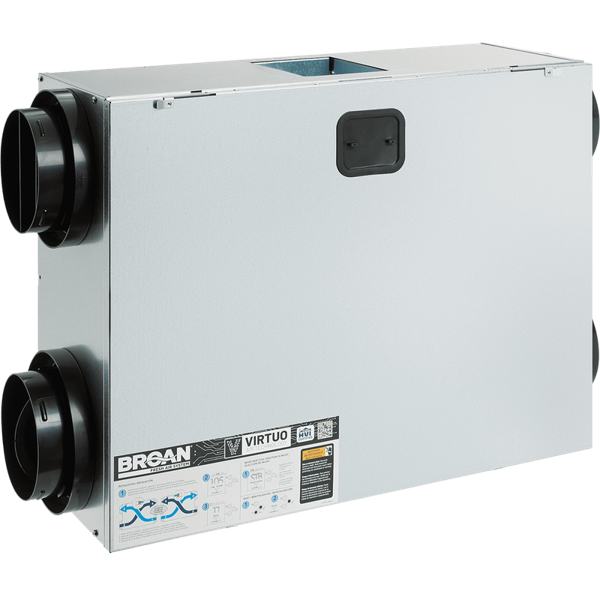
Broan ONE BLP150E75 ERV
Best for: Mid-size ducted homes in climates where winter rarely approaches -13°F.
You set the airflow in 1 CFM steps anywhere from 32 to 146 CFM at 0.4 inch of static pressure, so it can run at exactly the rate 62.2 gives your house instead of the nearest preset. At 64 CFM Broan rates it at 78% sensible recovery on 31 watts, and at 36 CFM it reaches 84%. It also costs the least of the ducted ERVs here.
In deep cold it falls behind, with 36% sensible recovery at -13°F where the B210E75R holds 65%. Controls sit on the unit itself, and Broan sells wall controls separately. The 5-year warranty covers both parts and core.
Strengths
- Airflow set in 1 CFM steps
- Lowest price of the ducted ERVs here
Limitations
- 36% recovery at -13°F (CSA test)
- Wall control sold separately
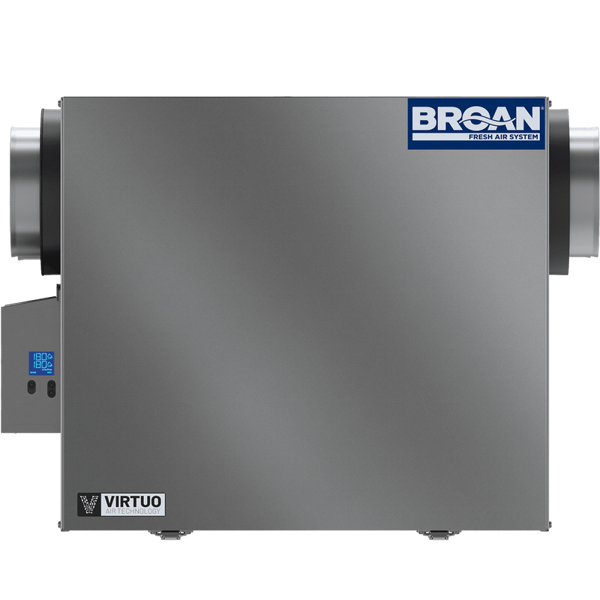
Broan B210E75R ERV
Best for: Houses whose 62.2 rate runs above about 105 CFM, and any house where winter nights reach the minus teens.
It moves 65 to 206 CFM at 0.4 inch, enough for a 5,000 sq ft, five-bedroom home, though at that home’s 195 CFM it runs near its top, where recovery falls; Broan lists 72% at 161 CFM. Its HVI-certified 65% sensible recovery at -13°F, measured at 83 CFM, is the strongest cold-weather figure here, and at 32°F it reaches 81% at 64 CFM on 28 watts.
The ONE costs far less, so pay the roughly 70% extra only for the airflow or the cold-climate figure. Defrost works by recirculation: from 23°F down, the unit periodically stops bringing in outdoor air and recirculates house air to clear frost from the core. It weighs about 47 lb assembled. Broan sells it as two models, the B210E75RS with side ports and the B210E75RT with top ports.
Strengths
- Highest airflow and cold-weather recovery here
- Fewest watts at 64 CFM of the ducted ERVs here
Limitations
- Highest price here
- Outdoor air pauses during defrost
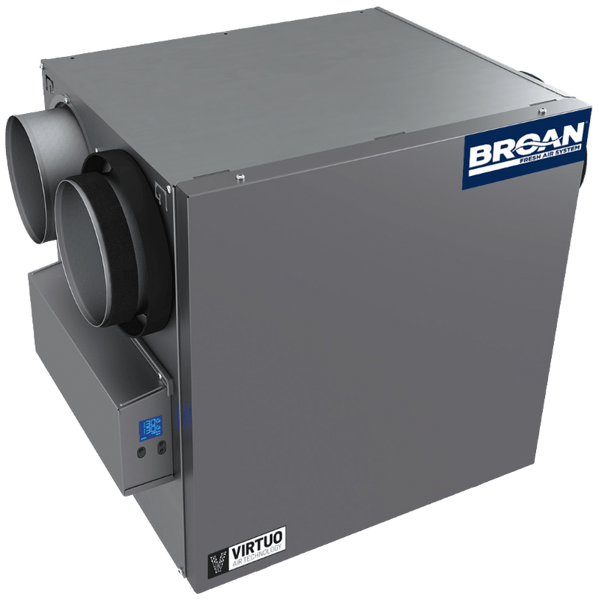
Broan B110H65R HRV
Best for: Homes needing up to 100 CFM, in cold climates where indoor humidity runs high in winter.
It holds 60% sensible recovery at -13°F, well ahead of the ONE in deep cold, and draws 26 watts at 64 CFM. Broan covers the core for a limited lifetime. Airflow tops out at 100 CFM at 0.4 inch, which covers the 2,000 sq ft, three-bedroom example in the sizing table and not much more.
Broan has discontinued the side-port version, the B110H65RS, and names the top-port B110H65RT as its replacement. Sylvane still lists both, so choose top ports when you order. Ducts are 5 inches, against 6 on the ONE and B210E75R.
Strengths
- 60% sensible recovery at -13°F, at the lowest price of the Broan units here
- Limited lifetime core warranty
Limitations
- Tops out at 100 CFM
- No moisture transfer in summer
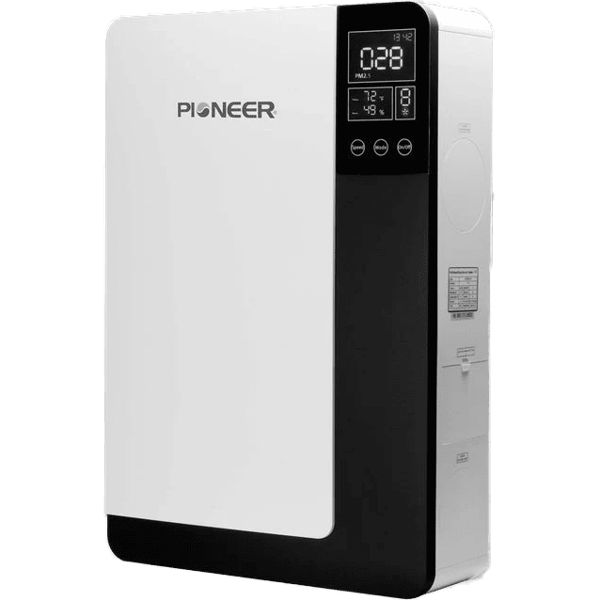
Pioneer ECOasis 150
Best for: A bedroom, office or addition of 200 to 500 sq ft with an exterior wall and no ductwork.
The ECOasis hangs on an exterior wall and needs two 4-inch holes, one for fresh air in and one for stale air out, so no duct runs through the house. Eight speeds take it up to 88 CFM on 12.6 to 43.8 watts, and Pioneer lists 22.6 to 37.9 dBA at 1.5 m across those speeds. Controls include a touch panel, a remote and a Wi-Fi app.
The data is thinner than Broan’s. Pioneer gives an 82% temperature efficiency with no test temperature or airflow and no HVI rating, and its product page lists 35 watts input while its catalog gives 43.8 at top speed. It serves one room and costs about 17% more than the ONE, which ventilates a whole house. Sylvane’s listing quotes up to 100 CFM; Pioneer’s own figure is 88.
Strengths
- No ductwork needed
- Published noise across all speeds
Limitations
- One room only
- No HVI-certified recovery rating
Also Compared: Broan B130E65R ERV
The B130E65R covers 35 to 119 CFM and suits a small to medium home, in Broan’s words. It trails the ONE at 32°F, with 67% sensible recovery at 66 CFM against the ONE’s 78% at 64, and it costs more. Its edge over the ONE is deep cold, 56% recovery at -13°F against 36%, though the B110H65R HRV beats that on sensible recovery for less, without the moisture transfer.
Frequently Asked Questions
Do I need a fresh air system if I already have bathroom fans?
Under ASHRAE 62.2 a bathroom exhaust fan running continuously at the whole-house rate can supply it, which is the low-cost route; our best bathroom exhaust fans guide compares the candidates. An exhaust fan pulls replacement air in through whatever gaps the house has, unheated and unfiltered. An ERV or HRV brings it in through a filter and passes the outgoing air’s heat to it on the way.
How much electricity does an ERV use?
Running all year at 64 CFM, the ONE’s rated 31 watts comes to about 272 kWh. The B210E75R at the same airflow draws 28 watts, about 245 kWh. At 110 CFM the ONE draws 70 watts, more than twice as much. At 161 CFM the B210E75R draws 147 watts, about 1,290 kWh a year.
Can I install an ERV myself?
The ducted Broan units connect to the outdoors and to the house’s duct system and need a wired electrical connection or a nearby outlet, depending on the version. Follow Broan’s installation guide and local mechanical code, and use a licensed HVAC contractor where your jurisdiction requires one. The Pioneer needs no ductwork, but it still means drilling two 4-inch holes through an exterior wall, sloped down toward the outside.
Is an ERV or HRV ENERGY STAR certified?
None of the four Broan units here is ENERGY STAR certified, according to Broan’s product pages; all four are HVI-certified, though the ONE’s -13°F figure comes from a CSA test. Pioneer lists neither for the ECOasis 150 on its own pages.